Transition belt
Delaware yard facts: grass, season and the rules that apply
Delaware lawns are mostly cool-season grass, with warm-season grass grown too, and the state has a nutrient law that reaches lawn fertilizer. Here is how that shapes the jobs, and who regulates the work.
By LawnElm Editorial Team Updated 6 min read
- Grass belt
- Transition
- Common grasses
- Tall fescue, bluegrass
- Fertilizer law
- Nutrient law applies
Short version
University of Delaware Cooperative Extension lists tall fescue, perennial ryegrass, fine fescue and Kentucky bluegrass as cool-season lawn grasses and bermudagrass and zoysiagrass as warm-season grasses, and publishes mowing and feeding dates for both. The Delaware Code sets a nutrient management program that requires certification for some commercial turf fertilizing and caps nitrogen on turf. The Delaware Department of Agriculture requires a pesticide business license for anyone who applies pesticides to another person's property for pay.
Delaware at a glance
Grass and climate
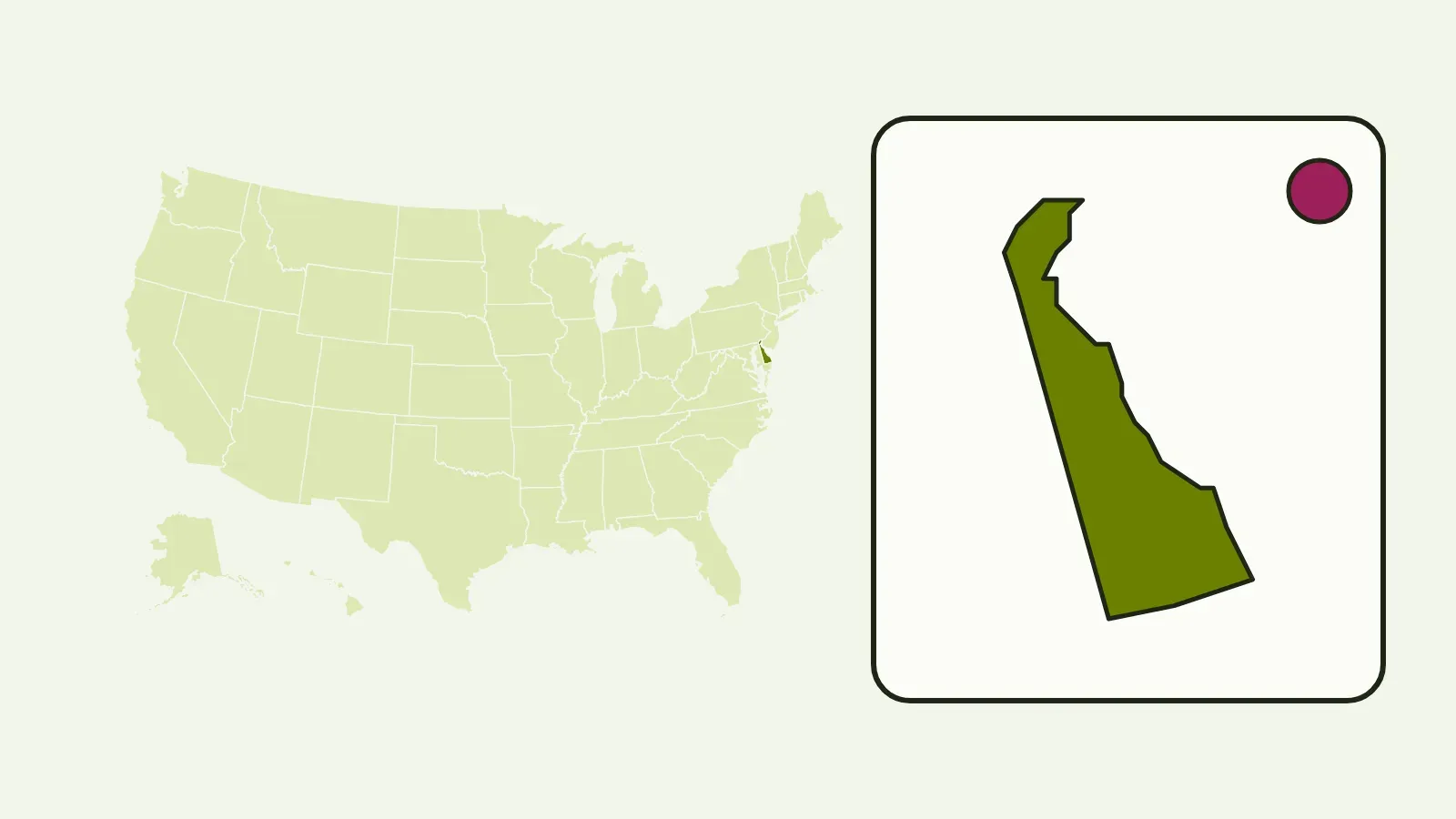
The University of Delaware's Livable Lawns guidance names two groups of lawn grass. Tall fescue, perennial ryegrass, fine fescue and Kentucky bluegrass are cool-season grasses. Bermudagrass and zoysiagrass are warm-season grasses. The university's monthly turfgrass calendar gives dates for both, which is why Delaware sits in the transition belt on the state map.
Cool-season and warm-season lawns run on different calendars. The calendar says cool-season mowing starts in late March to early April, once the turf is actively growing, and generally ends around November 15. Warm-season mowing starts in late April to early May and ends by early October, and warm-season grasses are dormant in January. It says cool-season grasses are seeded in fall, and warm-season grasses are seeded or sodded in late spring when frost is no longer expected.
Mowing and feeding
The University of Delaware calendar gives a mowing height for each kind of grass, and the one-third rule: do not remove more than 33 percent of the leaf in one mowing. See lawn mowing for how the rule sets your schedule.
| Grass | Kind | Mowing height |
|---|---|---|
| Cool-season grasses | Cool-season | 3 to 4 inches |
| Warm-season grasses | Warm-season | 2 to 3 inches |
For feeding, the calendar says early fall, September to mid-October, is the best time to apply nitrogen to cool-season grasses, and that fall fertilizer should be finished by November 15. For warm-season grasses it says to fertilize only from about late April to early September. It advises against nitrogen rates above 1 pound per 1,000 square feet and suggests products with more than 30 percent slow-release nitrogen.
Livable Lawns lists a yearly total of 1.5 to 3 pounds of nitrogen per 1,000 square feet, says spring feeding is optional and only used for quick green-up, and recommends leaving feeding until fall. It also advises leaving the clippings on the lawn and keeping a no-mow buffer around waterways. Turn a label rate into bags with the lawn supplies tool.
Rules for fertilizer and spraying
Delaware regulates lawn fertilizer through its nutrient management program, in Title 3, Chapter 22, Subchapter III of the Delaware Code. Section 2241 says people who apply nutrients to turf totaling more than a quarter acre (10,890 square feet) as part of a commercial venture must be certified or use a certified person or firm. A commercial nutrient handler is defined there as someone who applies nutrients to turf or land as part of a business for a fee. Workers under the direct supervision of a certified handler at the same location are not required to be certified separately.
Section 2250 sets two turf limits. No more than 4.8 pounds of nitrogen per 1,000 square feet of turf may be applied per year unless a nutrient management plan specifies otherwise. Phosphorus may not be applied to turf unless an approved lab soil test confirms a deficiency, or the application is to establish, re-establish or repair a turf area. The Delaware Department of Agriculture says the state's nutrient regulations bar certified nutrient handlers, meaning commercial applicators, from applying fertilizer from December 7 to February 15. The statute sections read for this page do not list those dates and do not say what a homeowner on a small lot must do, so confirm with the state before you rely on them.
For pesticides, the Delaware Department of Agriculture's Pesticide Management section says a business license is required to engage in the business of applying pesticides to the property of another. People treating property they own, lease or operate are exempt. The closest category to lawn work is 03, ornamental and turf pest control, covering the maintenance of ornamental trees, shrubs, flowers and turf. The department says category 03 businesses must mark service vehicles with the business name and license number, carry proof of financial responsibility, register every employee who applies or handles pesticides, and keep application records for two years. Anyone applying pesticides to another person's land for hire must be certified and obtain a pesticide business license.
The sources listed below do not describe a separate state license for a mowing or landscaping crew. Mowing and basic yard work are not the same as spraying or fertilizing, so ask any company that offers those services what it holds.
- The business's Delaware pesticide business license number
- Proof that the person applying fertilizer on a commercial job is certified, or works under a certified handler
- The product name and the rate, in writing
Call before you dig and local rules
Miss Utility's Delaware page says excavators in Delaware are to give notice two full working days before the day they plan to start work, and that the day you call does not count. It says a ticket stays valid if work begins within ten working days, and that a 24-inch zone around marked lines is off limits to mechanized equipment. It names Title 26, Chapter 8 of the Delaware Code as the governing law.
The Delaware Code page for that chapter words the excavator's duty differently. Section 806 reads not less than 3 business days, but no more than 12 business days, before the work begins, and section 808 exempts the owner of a private residence from the penalty section for work done entirely on their own land; the exemption covers only that section, and civil liability remains. The two pages do not match, so call as early as you can and follow the ticket you are given. The steps are in call 811 before you dig.
Cities, counties and homeowners' associations can add rules for grass height, watering and yard work. No particular ordinance is covered here, so read yours or ask the city office. The guide to HOA and city yard rules lists what to look for.
Hiring a crew in Delaware
Ask for the pesticide business license number before anyone sprays, ask who is certified to apply fertilizer on a commercial job, and get the product and the rate in writing. The guide to hiring a lawn crew lists what a written quote should say.
Questions people ask
What kind of grass do most Delaware lawns have?
Both kinds are grown. The University of Delaware lists tall fescue, perennial ryegrass, fine fescue and Kentucky bluegrass as cool-season grasses, and bermudagrass and zoysiagrass as warm-season grasses.
When should I fertilize a Delaware lawn?
It depends on the grass. The University of Delaware calendar says September to mid-October is the best time for cool-season grasses, with fall feeding done by November 15, and that warm-season grasses are fed from about late April to early September.
Does a lawn crew need a license to spray in Delaware?
Yes. The Delaware Department of Agriculture says a pesticide business license is required to apply pesticides to the property of another, and that anyone doing so for hire must be certified.
Is there a limit on lawn nitrogen in Delaware?
Section 2250 of Title 3 of the Delaware Code says no more than 4.8 pounds of nitrogen per 1,000 square feet of turf may be applied per year unless a nutrient management plan specifies otherwise. University of Delaware guidance is lower, at 1.5 to 3 pounds a year.
Sources
- Pesticide Business Licenses (Delaware Department of Agriculture)
- Pesticide Applicators (Delaware Department of Agriculture)
- Title 3, Chapter 22, Subchapter III, State Nutrient Management Program (Delaware Code)
- Monthly Turfgrass Management Guidelines Calendar (University of Delaware Cooperative Extension)
- Delaware Livable Lawns (University of Delaware Cooperative Extension)
- Title 26, Chapter 8, Subchapter I, Underground Utility Damage Prevention (Delaware Code)
- Delaware (Miss Utility of Delmarva)
Checked on November 20, 2026. Licensing rules, nutrient rules and local ordinances change; confirm with the Delaware Department of Agriculture, your county extension office and your city before you hire, fertilize or spray.
Next in the yard
-

Yard job
Lawn mowing
How tall to mow, how often, and what a weekly visit includes.
-

Yard job
Lawn fertilizing
When to feed cool- and warm-season lawns, how to size a feeding, and what rules apply.
-

Guide
Call 811 before you dig
How the free 811 locate works, why notice periods differ by state, and who calls when a crew digs.