Warm belt
Florida yard facts: grass, season and the rules that apply
Florida lawns are warm-season grass. The state sets a fertilizer rule, licenses lawn spraying for hire and asks for two full business days of notice before you dig.
By LawnElm Editorial Team Updated 6 min read
- Grass belt
- Warm-season
- Common grasses
- St. Augustine, bahia
- Fertilizer law
- State rule, county rules
Short version
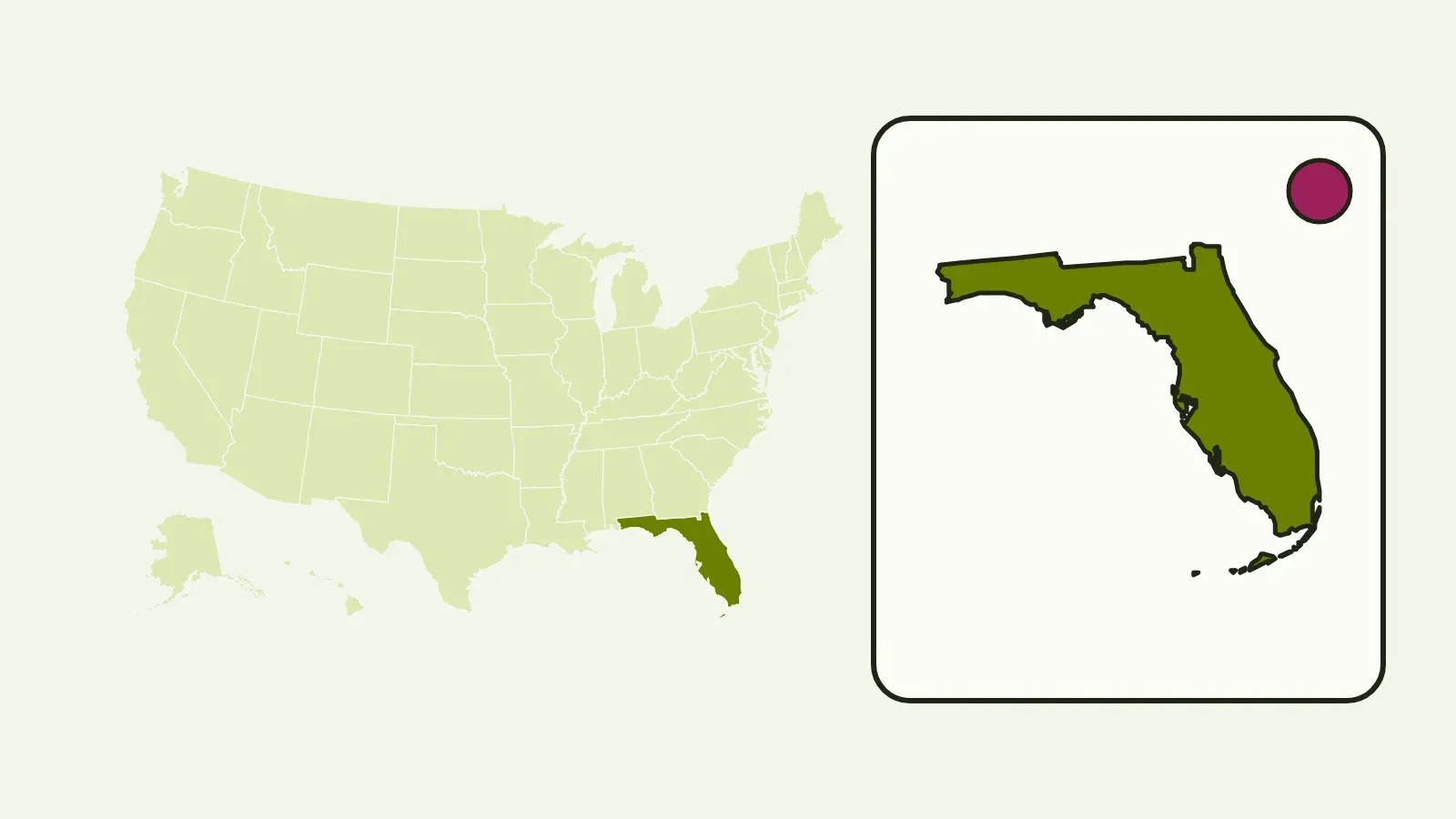
Florida lawns are warm-season grasses such as St. Augustinegrass, bahiagrass, bermudagrass and zoysiagrass. UF/IFAS says most lawns in the state go dormant in winter. The Florida Department of Agriculture and Consumer Services (FDACS) licenses lawn spraying for hire and certifies commercial fertilizer applicators, and most urbanized counties add their own fertilizer ordinances.
Florida at a glance
Grass and climate
UF/IFAS Extension lists five grasses as adapted statewide: bahiagrass, bermudagrass, seashore paspalum, St. Augustinegrass and zoysiagrass. Centipedegrass is listed for North Florida and the Panhandle, and a selection called 'Hammock' centipedegrass is noted as adapted to South Florida. UF/IFAS also says most Florida lawns go dormant in winter, so the mowing, feeding and watering jobs on your yard calendar follow the grass, not the date.
Shade and salt change the choice. In the UF/IFAS selection table, St. Augustinegrass and zoysiagrass rate good for shade, depending on the cultivar, while bahiagrass, bermudagrass and seashore paspalum rate poor. For salt tolerance, seashore paspalum rates excellent and bahiagrass very poor. If your lot is shady or near the coast, ask your county extension office which grass has held up nearby before you sod or reseed.
- St. Augustinegrass rates good for shade in the UF/IFAS table, depending on the cultivar.
- Bahiagrass is a low-maintenance grass that UF/IFAS says is often mowed mainly to remove seedheads.
- Bermudagrass and zoysiagrass are mowed lower and more often than St. Augustinegrass.
Mowing and feeding
UF/IFAS gives a mowing height for each grass, and one rule for all of them: never remove more than one third of the leaf blade in a mowing. A St. Augustinegrass lawn kept at 4 inches should be mowed before it reaches 6 inches. See lawn mowing for how the rule sets the schedule.
| Grass | Optimal height | Frequency |
|---|---|---|
| St. Augustinegrass | 2.5 to 4 inches | Every 5 to 14 days |
| Bermudagrass | 0.5 to 1.5 inches | Every 3 to 5 days |
| Bahiagrass | 3 to 4 inches | Every 7 to 17 days |
| Zoysiagrass | 1 to 3 inches | Every 10 to 14 days |
| Centipedegrass | 1.5 to 2 inches | Every 10 to 14 days |
UF/IFAS adds that only dwarf St. Augustinegrass varieties should be mowed below 3 inches. For feeding, its lawn practices page says to fertilize only in the growing season, to make the last application around the end of September in North Florida and mid-October in Central Florida, and to leave a 10-foot unfertilized buffer next to water. It also says to get a soil test first, because many Florida soils already have enough phosphorus. The lawn supplies tool turns a label rate into bags.
Rules for fertilizer and spraying
Fertilizer. FDACS adopted a statewide urban turf fertilizer rule in 2007 (Florida Administrative Code 5E-1.003(2)). A UF/IFAS publication on the rule says a product may supply up to 2 pounds of nitrogen per 1,000 square feet at one time in spring or summer if at least 65 percent of it is controlled-release, and no more than 0.7 pound of soluble nitrogen at one time. It limits phosphorus (as P2O5) to 0.25 pound per 1,000 square feet per application and 0.50 pound a year unless a soil test shows a deficiency, with a one-time starter allowance for a new lawn.
Commercial fertilizer applicators. Florida Statute 482.1562 requires a limited certification for anyone who applies commercial fertilizer to an urban landscape, with an exemption for yard workers who apply only fertilizer and equipment supplied by an individual residential owner. The certification does not let the holder apply pesticides to turf. If a crew feeds your lawn, ask to see its certificate.
Pesticides. FDACS issues the licenses. A UF/IFAS county office explains that commercial workers who apply pesticides in yards must work under a licensed Lawn and Ornamental Pest Control operator or hold their own FDACS limited certification. An FDACS handout says the Limited Certification for Commercial Landscape Maintenance covers plant beds and ornamentals only: it does not allow applications to lawns or turfgrass. A mowing crew with that certificate may not spray your turf.
Call before you dig. Sunshine 811 says to notify it at least two full business days before you want to dig, and that business days exclude weekends and state and national holidays. The request is free. Read call 811 before you dig before a fence, a tree or a sprinkler repair.
Local rules
UF/IFAS says most urbanized Florida counties have their own fertilizer ordinances, so check yours before feeding. It also says water management district restrictions take priority over its watering tips, so look up your district's current watering days. Homeowners' associations and cities can add rules on grass, fences and mowing height; the HOA and city yard rules guide covers how to find them.
Hiring a crew in Florida
A mowing crew and a spraying crew are different jobs under Florida rules. Ask any company that offers weed, insect or fungus treatments for its license or certificate number, and ask what the certificate covers. Get the product and the area treated in writing. The guide to hiring a lawn crew lists what a written quote should say.
Questions people ask
What grass do most Florida lawns have?
UF/IFAS lists bahiagrass, bermudagrass, seashore paspalum, St. Augustinegrass and zoysiagrass as adapted statewide. Centipedegrass is listed for North Florida and the Panhandle.
How tall should I mow St. Augustinegrass in Florida?
UF/IFAS gives 2.5 to 4 inches, and says only dwarf varieties should be mowed below 3 inches. Mow before the grass has grown more than one third above the height you keep.
Does Florida limit lawn fertilizer?
Yes. A state rule from FDACS limits nitrogen and phosphorus in lawn fertilizer products, and commercial applicators need a limited certification under Florida Statute 482.1562. UF/IFAS also says most urbanized counties have their own ordinances.
Can a landscape maintenance crew spray my lawn for weeds?
Not under the Limited Certification for Commercial Landscape Maintenance, which FDACS says covers plant beds and ornamentals but not lawns or turfgrass. Spraying turf for hire takes a Lawn and Ornamental license or certification.
How much notice does Florida's 811 service need?
Sunshine 811 says to notify it at least two full business days before you want to dig. Weekends and holidays do not count.
Sources
- Mowing Your Florida Lawn (UF/IFAS Gardening Solutions)
- Mowing Your Florida Lawn, LH028 (UF/IFAS EDIS)
- Best Management Practices for Your Lawn (UF/IFAS Gardening Solutions)
- Selecting a Florida turfgrass fact sheet (UF/IFAS Extension Baker County)
- Urban turf fertilizer rule, EP353 (UF/IFAS EDIS)
- Florida Statute 482.1562, limited certification for commercial fertilizer application (Florida Senate)
- Licensing and certification for the green industry professional (UF/IFAS Extension Martin County)
- Certification requirements for commercial landscape maintenance operators (FDACS)
- When can I dig? (Sunshine 811)
Checked on November 20, 2026. Licensing rules and local ordinances change; confirm with FDACS and your county or city before you hire or spray.
Next in the yard
-

Yard job
Lawn fertilizing
When to feed cool- and warm-season lawns, how to size a feeding, and what rules apply.
-
Yard job
Lawn watering and irrigation
How much water lawns need by belt, when to run sprinklers, and what an irrigation quote lists.
-

Guide
Call 811 before you dig
How the free 811 locate works, why notice periods differ by state, and who calls when a crew digs.