Warm belt
Hawaii yard facts: grass, certification and the rules that apply
Hawaii lawns are warm-season grasses such as bermudagrass, zoysiagrass and St. Augustine. Here is how that shapes the jobs, and what to check before you hire, spray or dig.
By LawnElm Editorial Team Updated 5 min read
- Grass belt
- Warm-season
- Common grasses
- Bermuda, zoysia
- Call 811 notice
- 5 working days
Short version
The University of Hawaii's College of Tropical Agriculture and Human Resources (CTAHR) says the turfgrasses used in Hawaii are warm-season grasses, and names bermudagrass, zoysiagrass, St. Augustine grass and seashore paspalum. The Hawaii Department of Agriculture and Biosecurity certifies pesticide applicators, including a turf and ornamental commercial category. Hawaii One Call asks excavators for at least five working days' notice before a dig.
Hawaii at a glance
Grass and climate
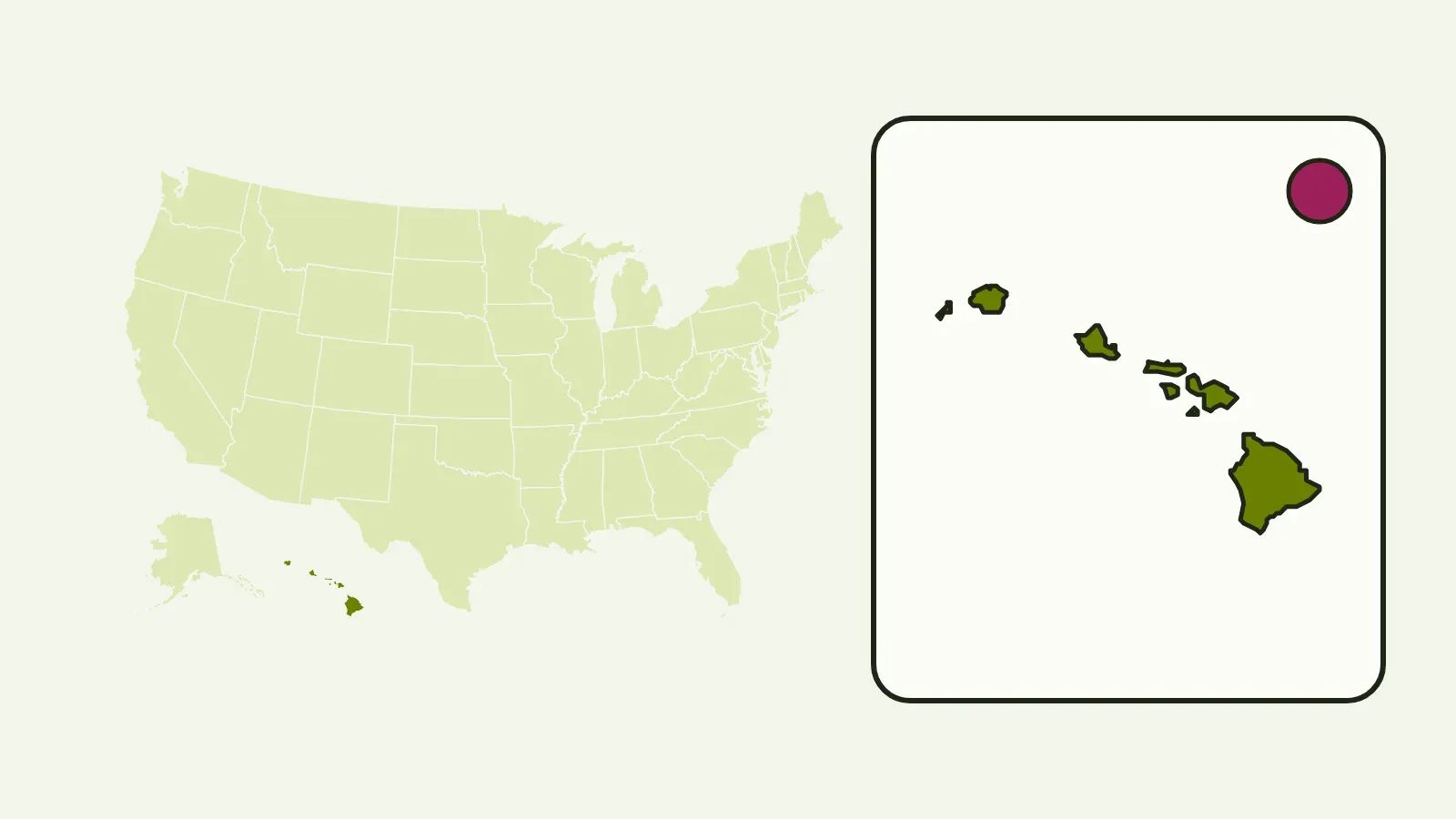
CTAHR's lawn guidance for Hawaii names four lawn grasses. Bermudagrass tolerates heat well. Zoysiagrass is relatively low maintenance. St. Augustine grass has the best shade tolerance. Seashore paspalum handles high water or soil salinity. CTAHR notes that the turfgrasses used in Hawaii are warm-season grasses that spread by rhizomes and stolons, which is why Hawaii sits in the warm belt on the state map.
CTAHR's guidance does not give a mowing calendar or say whether a Hawaii lawn grows all year, so this page does not either. Growth depends on the grass, the shade, the water and where in the islands you live. Your county extension office can tell you what has held up nearby. The jobs on your yard calendar should follow your grass, not the date.
- Bermudagrass is used for lawns, parks, utility turf, golf courses and athletic fields. A UH Extension specialist's slides call it a high-maintenance choice with low shade tolerance.
- Zoysiagrass is low-growing and wear-resistant, and does not like compacted soil, according to the same slides.
- Seashore paspalum suits salty soil or irrigation water, including areas near the ocean. The slides say it needs frequent mowing to hold a low cut.
Mowing and feeding
A 2017 slide deck from a CTAHR extension specialist lists mowing heights for the grasses above. It also gives the one-third rule: try not to remove more than a third of the blade at one time. See lawn mowing for how the rule sets your schedule.
| Grass | Mowing height |
|---|---|
| Bermudagrass (common) | 0.5 to 1 inch |
| St. Augustinegrass | 2 to 3 inches |
| Zoysiagrass | 0.5 to 2 inches |
The slides give no height for seashore paspalum. They say rotary mowers suit cuts above 1 inch and reel mowers suit cuts below 1 inch.
For feeding, CTAHR says to fertilize as necessary, to base fertilizer at planting on a soil test, and to avoid excess nitrogen, which it says can encourage fungal disease and weak blades. It gives no rates or dates, so follow your fertilizer label. The lawn supplies tool turns a label rate into bags. CTAHR also advises watering deeply and infrequently, early in the morning if possible.
Who regulates what
The Hawaii Department of Agriculture and Biosecurity (DAB), through its Plant Industry Division and Pesticides Branch, certifies pesticide applicators. Its FAQ says applicators are either private, meaning farmers working land they or their employer operate, or commercial, meaning everyone else. It says there are 11 categories of commercial applicator and names Ornamental and Turf Pest Control as one of them.
DAB's 2019 list of certification categories shows that category as Commercial 3, Turf and Ornamental. DAB's certification page says every commercial category requires passing the Core exam first, and that certifications are valid for five years. The category list does not describe what category 3 covers and sends readers to a county environmental health specialist.
One point is easy to miss. DAB's FAQ says you need to be certified only if you use restricted-use pesticides. The pages read for this article do not say whether a crew that sprays only general-use products on a lawn for pay needs certification. So when a crew offers to spray, ask which products it will use, whether it holds DAB certification, and for a copy. DAB's Pesticides Branch can answer at (808) 973-9402.
DAB's category list also says categories 7a, 7b and 7c, which cover fumigation, termite and general pest control, are for employees of pest control businesses licensed by the Department of Commerce and Consumer Affairs. That is structural pest work, not lawn work.
The DAB pages read do not cover fertilizer use, and this article found no statewide homeowner fertilizer rule in the sources it checked. That is not the same as saying none exists. Ask DAB, your county and your homeowners' association. This article also did not confirm whether Hawaii requires a separate state license for lawn mowing or landscape work.
Call 811 and local rules
Hawaii's Excavation Handbook, Sixth Edition (April 2021), says an excavator must notify Hawaii One Call at least five working days, but not more than twenty-eight calendar days, before excavation begins, under Hawaii Revised Statutes section 269E-7. To request a locate, dial 811. The handbook defines a working day as 7 a.m. to 5 p.m., excluding weekends and holidays.
The handbook does not address homeowners by name, and it describes exceptions, such as certain improvements to a one- or two-family home on a lot of two acres or less. Whether your project qualifies depends on those conditions, so when in doubt, call. The steps are in call 811 before you dig.
Counties, water systems and homeowners' associations can add rules for watering, grass height and yard work. No particular ordinance is covered here, so read yours or ask the local office. The guide to HOA and city yard rules lists what to look for.
Hiring a crew in Hawaii
Ask any company that sprays, fertilizes or removes trees for its license or certification number, and for the product and rate in writing. If it digs for a fence post or a planting hole, ask who calls 811. The guide to hiring a lawn crew lists what a written quote should say.
Questions people ask
What kind of grass do most Hawaii lawns have?
Warm-season grasses. CTAHR names bermudagrass, zoysiagrass, St. Augustine grass and seashore paspalum, and says turfgrasses used in Hawaii are warm-season grasses.
Which agency certifies pesticide applicators in Hawaii?
The Hawaii Department of Agriculture and Biosecurity, through its Pesticides Branch. It lists Turf and Ornamental as Commercial category 3 and says certifications last five years.
How much notice does Hawaii One Call need?
The 2021 Excavation Handbook says at least five working days, but not more than twenty-eight calendar days, before excavation begins. Dial 811 to request a locate.
Do I need a license to mow lawns for pay in Hawaii?
The sources read for this page do not say. Ask the Hawaii Department of Commerce and Consumer Affairs or your county before you start.
Sources
- Pesticide Applicator Certification/Recertification (Hawaii Department of Agriculture and Biosecurity)
- FAQ for Pesticides (Hawaii Department of Agriculture and Biosecurity)
- Categories of Certification for Pesticide Applicators in Hawaii, February 2019 (Hawaii Department of Agriculture via CTAHR)
- The Care and Feeding of Your Lawn, June 2020 (UH CTAHR)
- Turf Management in Hawaii, 2017 Master Gardener class slides (UH CTAHR)
- Hawaii Excavation Handbook, Sixth Edition, April 2021 (Hawaii Department of Commerce and Consumer Affairs)
Checked on November 20, 2026. Licensing rules and local ordinances change; confirm with the Hawaii Department of Agriculture and Biosecurity, your county and Hawaii One Call before you hire, spray or dig.
Next in the yard
-

Yard job
Lawn mowing
How tall to mow, how often, and what a weekly visit includes.
-

Guide
Call 811 before you dig
How the free 811 locate works, why notice periods differ by state, and who calls when a crew digs.
-

Guide
How to hire a lawn crew
Licenses, insurance and written quotes to check before a lawn or landscape crew starts work.