Cool belt
Idaho yard facts: grass, season and the rules that apply
Most Idaho lawns are cool-season grass that grows fastest in spring and fall and slows in summer heat. Here is how that shapes the jobs, and what to check before you hire, spray or dig.
By LawnElm Editorial Team Updated 6 min read
- Grass belt
- Cool-season
- Common grasses
- Bluegrass, fescues
- Call 811 notice
- 2 to 10 business days
Short version
University of Idaho Extension says most Idaho home lawns use Kentucky bluegrass, perennial ryegrass, tall fescue, fine fescue, or a mix of them, all cool-season grasses that grow fastest when soil is about 55 to 65 degrees F. The Idaho State Department of Agriculture licenses professional pesticide applicators, including an Ornamental Pest category that covers turf. Idaho law asks excavators to give 2 to 10 business days' notice before they dig.
Idaho at a glance
Grass and climate
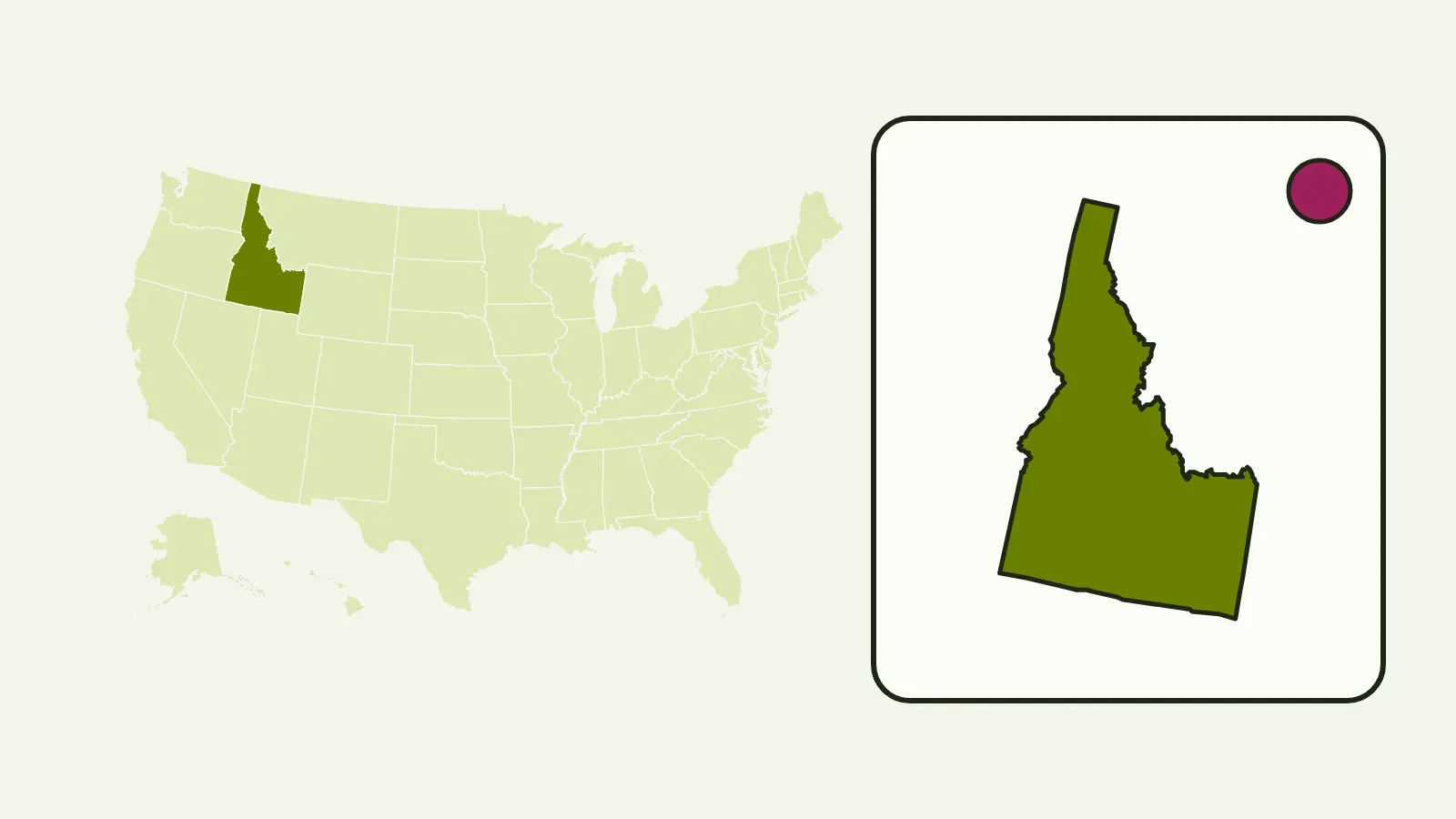
University of Idaho Extension says most Idaho home lawns use Kentucky bluegrass, perennial ryegrass, tall fescue, fine fescue, or a mix of these. It calls all four cool-season grasses, which grow fastest when soil temperatures are about 55 to 65 degrees F, slow in summer heat, and suit northern regions. That is why Idaho sits in the cool belt on the state map.
The extension lawn page also marks some edges inside the state. Southern Idaho has a dry climate, and its high-pH soils tie up iron, which can turn grass yellow. Perennial ryegrass is not very cold hardy and is best suited to the lower Snake River plains. Short seasons at higher elevations can thin tall fescue. Crabgrass starts to germinate from mid-March to early April in the Treasure Valley, Magic Valley and northern Idaho, and from late March to mid-April in central and eastern Idaho.
- Kentucky bluegrass spreads, tolerates cold and does best in full sun. It is prone to thatch and, in shade, powdery mildew.
- Tall fescue is heat and drought tolerant and handles shade better than bluegrass or ryegrass.
- Fine fescues are low maintenance, very shade tolerant and drought tolerant, but do not handle heat or heavy traffic well.
- Buffalograss is the one warm-season grass the page covers. It can stay dormant up to seven months a year in Idaho, grows from about mid-May to mid-September, and is not recommended above 6,000 feet.
Mowing, feeding and watering
University of Idaho Extension says a mowing height of 3 inches is a good target for most home lawns, and that you should never go below 2 inches. It gives the one-third rule: never remove more than a third of the leaf blade at one mowing, so a lawn kept at 3 inches gets mowed when it reaches 4.5 inches. It says to keep mowing into October and sometimes November, until growth stops. See lawn mowing for how the rule sets your schedule.
| Grass | Mowing height |
|---|---|
| Kentucky bluegrass | 2 to 3.5 inches |
| Perennial ryegrass | 2 to 3 inches |
| Tall fescue | 2 to 3.5 inches |
| Fine fescues | About 2 inches, up to 2.5 in shade |
| Buffalograss | 2.5 to 4 inches |
For feeding, the same page gives a calendar for a medium-to-high-input Kentucky bluegrass lawn, in pounds of nitrogen per 1,000 square feet: 0.5 to 1 from mid-March to April, 1 from early May to June, none in July to early August, 1 from mid-August to September, and 1 to 2 from early October to November. It says to avoid summer fertilizing except to prevent yellowing from iron chlorosis. Your fertilizer label and soil set the real rate, and the lawn supplies tool turns a label rate into bags.
For water, the extension page puts Kentucky bluegrass and perennial ryegrass at about 1 inch a week from April to mid-May, about 2 inches a week or slightly more from late May to mid-August, and just over 1 inch from mid-August to late September. It says to water early in the morning and to irrigate until the end of October or into the second week of November, earlier in colder areas. See lawn watering and irrigation.
Who regulates what
The Idaho State Department of Agriculture (ISDA) licenses pesticide applicators. University of Idaho Extension says ISDA sets the statewide pesticide exams and approves the study manuals. ISDA's list of license categories says the Ornamental Pest (OP) category is for professional applicators who use or supervise pesticides on ornamental plants and turf, and that the Core category is required for all Idaho professional applicator licenses.
ISDA's licensing guide says professional licenses are valid for five years and need 40 recertification credits to renew. It also describes a Commercial Apprentice license, valid for two years, that covers general-use pesticide applications under the limited supervision of a certified professional. The ISDA pages read do not say outright who must hold a license to spray a lawn for pay, so if a crew offers to spray, ask for its ISDA license category and a copy.
For fertilizer, ISDA's page lists Idaho Code Title 22, Chapter 6, Commercial Fertilizers, as the law, along with a registrations and licenses rule. The page does not describe what those require, and it does not mention limits on how a homeowner applies lawn fertilizer. This article did not confirm either way, so ask ISDA, your city and your homeowners' association. It also did not confirm whether Idaho requires a state license for lawn mowing or landscape work.
Call 811 and local rules
Idaho's Guide to Safe Digging for 2026 to 2027 says that under Idaho Code 55-2205, notice must be given not less than two business days nor more than ten business days before the scheduled date of excavation, unless the parties agree otherwise in writing. If the dig has not started within three weeks of the notice, the excavator must renew it. Dial 811. The guide lists Digline, Inc. (800-342-1585) for most counties, with separate centers for Boundary, Bonner and Kootenai counties and for Benewah and Shoshone counties.
The guide says all excavators must call. Idaho Code 55-2210 exempts some shallow work, such as digging less than 15 inches deep on private property outside a utility easement, but not where there is reason to believe an underground facility is present. When in doubt, call. The steps are in call 811 before you dig.
Cities, irrigation districts and homeowners' associations can add rules for watering, grass height and yard work. No particular ordinance is covered here, so read yours or ask the local office. The guide to HOA and city yard rules lists what to look for.
Hiring a crew in Idaho
Ask any company that sprays or fertilizes for its ISDA license category and the product and rate in writing. If a crew digs for a fence post or a planting hole, ask who calls 811. The guide to hiring a lawn crew lists what a written quote should say.
Questions people ask
What kind of grass do most Idaho lawns have?
Cool-season grasses. University of Idaho Extension says most home lawns use Kentucky bluegrass, perennial ryegrass, tall fescue, fine fescue, or a mix.
How tall should I mow an Idaho lawn?
University of Idaho Extension calls 3 inches a good target for most home lawns and says never to go below 2 inches. Kentucky bluegrass and tall fescue range from 2 to 3.5 inches.
Which Idaho pesticide license covers lawns?
ISDA's Ornamental Pest (OP) category is for professional applicators who use or supervise pesticides on ornamental plants and turf. The Core category is required for all professional licenses.
How much notice does Idaho require before digging?
Idaho's Guide to Safe Digging says notice must be given not less than two business days nor more than ten business days before excavation begins, unless the parties agree otherwise in writing.
Sources
- Lawn (University of Idaho Extension)
- Pesticide Safety (University of Idaho Extension)
- License Categories Defined, 2024 IDAPA rule update (Idaho State Department of Agriculture)
- Licensing 101 (Idaho State Department of Agriculture)
- Feed and Fertilizer Laboratory (Idaho State Department of Agriculture)
- Idaho Guide to Safe Digging 2026-2027 (Idaho Division of Occupational and Professional Licenses)
Checked on November 20, 2026. Licensing rules and local ordinances change; confirm with the Idaho State Department of Agriculture, your city and your 811 center before you hire, spray or dig.
Next in the yard
-

Yard job
Lawn mowing
How tall to mow, how often, and what a weekly visit includes.
-

Yard job
Lawn fertilizing
When to feed cool- and warm-season lawns, how to size a feeding, and what rules apply.
-

Yard job
Lawn watering and irrigation
How much water lawns need by belt, when to run sprinklers, and what an irrigation quote lists.