Cool belt
Iowa yard facts: grass, season and the rules that apply
Iowa lawns are cool-season grass, mowed from April until growth stops in late October or early November. The state licenses anyone who applies pesticides to other people's property.
By LawnElm Editorial Team Updated 5 min read
- Grass belt
- Cool-season
- Common grasses
- Kentucky bluegrass
- Spray for hire
- License required
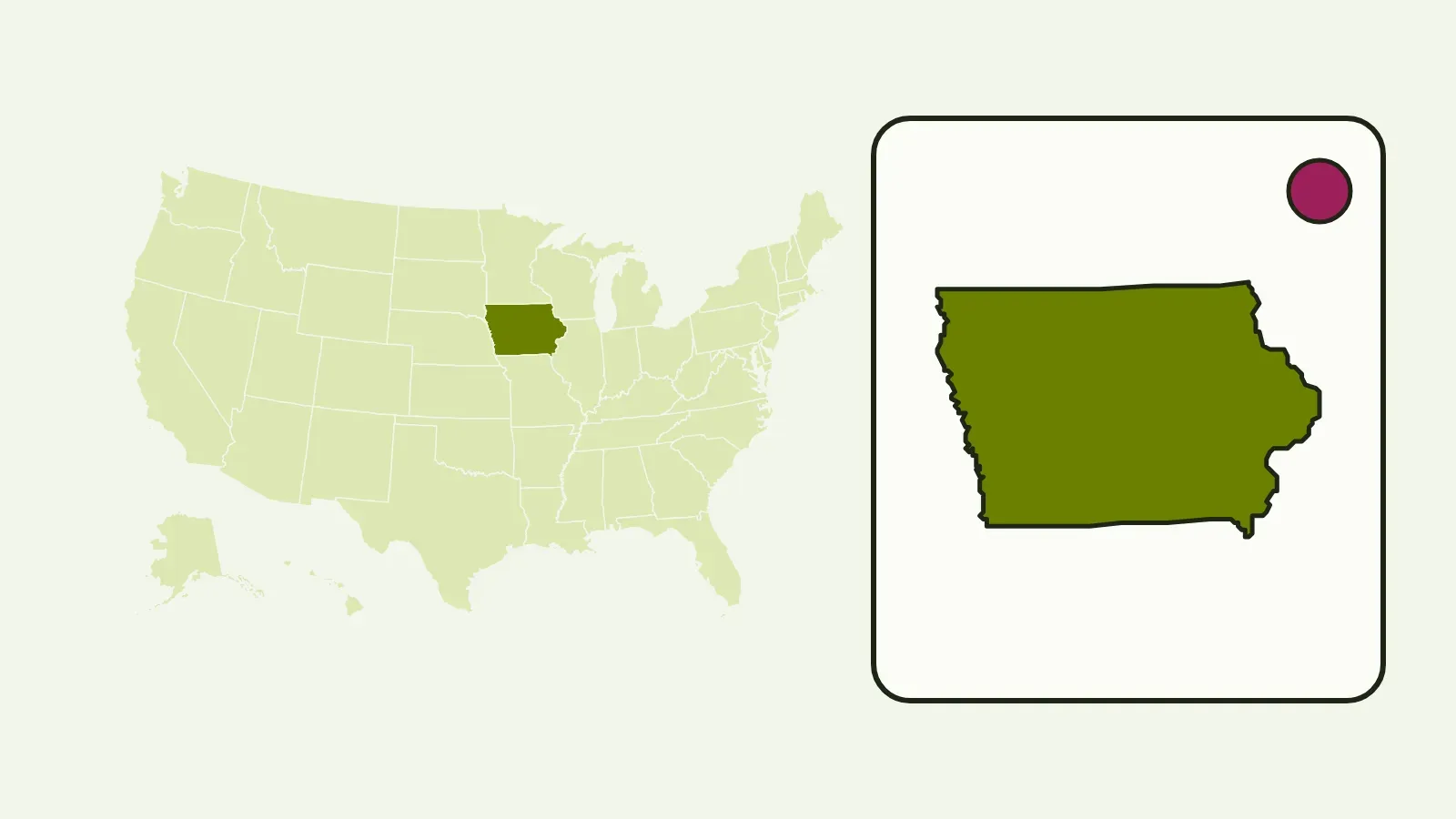
Short version
Iowa State University Extension calls the cool-season grasses, with Kentucky bluegrass the example, the common Iowa lawn grasses. It says to mow at 2.5 to 3 inches in spring and to keep mowing until bluegrass stops growing in late October or early November. Under the Pesticide Act of Iowa, a business that applies pesticides to other people's property needs a license from the state Secretary of Agriculture.
Iowa at a glance
Grass and climate
Iowa State University Extension says hot, dry summers are tough on the cool-season grasses that are common in Iowa lawns. Its lawn calendars use Kentucky bluegrass as the example, and they treat September and April as the best times to aerate Kentucky bluegrass and other cool-season lawns. That puts Iowa in the cool-season belt, so the cool-season jobs on your yard calendar are the ones that apply.
Extension says April is when most spring yard tasks begin. It says a September seeding is much more successful than a spring one, and that the best time to start a lawn from seed is mid-August to mid-September. The same page says the best time to renovate a thin lawn is mid-August through mid-September.
Mowing and feeding
Iowa State says a mower height of 2.5 to 3 inches is optimum for most turfgrasses in Iowa, and that you should never remove more than one third of the leaf in one mowing. In its example, when the grass reaches 4 inches you mow it back to 3 inches. Expect to mow about once a week in spring. Clippings of one to one and a half inches fall back into the lawn and need not be bagged. See lawn mowing for how the one-third rule works.
In mid- to late September, Extension says to lower the cut from 3.0 to 3.5 inches to 2.5 to 3 inches, then keep mowing until the grass stops growing. Kentucky bluegrass stops growing when daytime highs stay below 50 F, usually in late October or early November. Once the foliage stops, the mower can be put away for winter.
- April: Extension suggests 0.75 pound of nitrogen per 1,000 square feet from a slow-release fertilizer.
- Mid-September: Extension calls this an excellent time to fertilize, with no more than 1 pound of actual nitrogen per 1,000 square feet.
- Soil test: Extension says many Iowa soils do not need added phosphorus, except at seeding, and suggests an early spring test.
After any application, sweep fertilizer off hard surfaces, and keep clippings out of storm sewers. The lawn supplies tool turns a label rate into bags.
Fertilizer and pesticide rules
The Pesticide Act of Iowa, Iowa Code chapter 206, says no person may engage in the business of applying pesticides to the lands or property of another without being licensed by the Secretary of Agriculture. A commercial applicator is a person, corporation or employee who contracts for payment to apply a pesticide. The Department of Agriculture and Land Stewardship issues the license, and the chapter says it may not issue one until the applicant has shown evidence of financial responsibility, such as a surety bond or liability insurance, and the person running the business has passed an examination for the classifications applied for.
Iowa updated its applicator certification and training rules to match EPA standards on January 1, 2026. The department's announcement says applicants take updated written or online exams. If a crew sprays your lawn, ask for its license number and for the product and rate in writing.
The sources used here do not give a statewide limit on phosphorus, a fertilizer blackout date or a certification rule for homeowner or commercial lawn fertilizer, and this page does not claim there is none. Ask the Department of Agriculture and Land Stewardship and your city what applies. The sources also do not cover a general lawn-care or landscaping business license, and the license classification that covers lawns was not confirmed, so ask the department which one a crew needs.
Calling 811 and local rules
The Iowa Utilities Commission says Iowa law requires underground utility lines to be marked before you dig by hand or with equipment. A homeowner or excavator contacts Iowa One Call at 811 or online, at least two days before starting, excluding Saturday, Sunday and legal holidays. The commission says utilities mark their lines or report none within 48 hours, and that Iowa One Call is free. Iowa One Call also lists planting a tree and putting in a fence as projects to call about. See call 811 before you dig.
Cities, towns and homeowners' associations can add their own rules for mowing, grass height, watering and yard work. This page did not verify any specific Iowa city ordinance, so check yours. The guide to HOA and city yard rules explains where to look.
Hiring a crew in Iowa
Mowing and raking are not pesticide work, but weed or insect treatments are. Ask for the license number, the product and the rate in writing. The guide to hiring a lawn crew lists what a written quote should say, and the yard budget tool turns quotes into a yearly total.
Questions people ask
What grass do Iowa lawns have?
Mostly cool-season grasses. Iowa State University Extension describes cool-season grasses as common in Iowa lawns and uses Kentucky bluegrass as its example.
How long do I mow an Iowa lawn in fall?
Until the grass stops growing. Extension says Kentucky bluegrass usually stops in late October or early November, when daytime highs stay below 50 F.
Does a lawn spraying company need a license in Iowa?
Yes. The Pesticide Act of Iowa says no person may engage in the business of applying pesticides to the property of another without a license from the Secretary of Agriculture.
How long before digging do I call 811 in Iowa?
The Iowa Utilities Commission says at least two days before you start, excluding Saturday, Sunday and legal holidays.
Sources
- Spring Lawn Care (Iowa State University Extension and Outreach)
- Late Summer and Fall Lawn Care (Iowa State University Extension and Outreach)
- Iowa Code chapter 206, Pesticides (Iowa Legislature)
- Updates to Pesticide Applicator Rules (Iowa Department of Agriculture and Land Stewardship)
- Iowa's One Call Law (Iowa Utilities Commission)
- Homeowner Safe Digging Information (Iowa One Call)
Checked on November 20, 2026. Licensing rules and local ordinances change; confirm with the Iowa Department of Agriculture and Land Stewardship and your city before you hire or spray.
Next in the yard
-

Yard job
Lawn mowing
How tall to mow, how often, and what a weekly visit includes.
-

Yard job
Snow removal
What snow weighs, how to shovel safely, and what a snow quote should say.
-

Guide
Call 811 before you dig
How the free 811 locate works, why notice periods differ by state, and who calls when a crew digs.