Transition belt
Kansas yard facts: grass, season and the rules that apply
Kansas lawns are a mix of cool-season and warm-season grass, and the feeding calendar differs for each. Here is how that shapes the jobs, and who regulates the work.
By LawnElm Editorial Team Updated 6 min read
- Grass belt
- Transition
- Common grasses
- Tall fescue, bluegrass
- Spray for hire
- License required
Short version
Kansas State University Research and Extension lists cool-season grasses (Kentucky bluegrass, tall fescue, perennial ryegrass) and warm-season grasses (bermudagrass, zoysiagrass, buffalograss) for Kansas lawns. The Kansas Department of Agriculture requires a pesticide business license for anyone who applies pesticides for compensation, and it registers fertilizers sold in the state. Kansas 811 asks for a standard notice of two full working days before you dig.
Kansas at a glance
Grass and climate
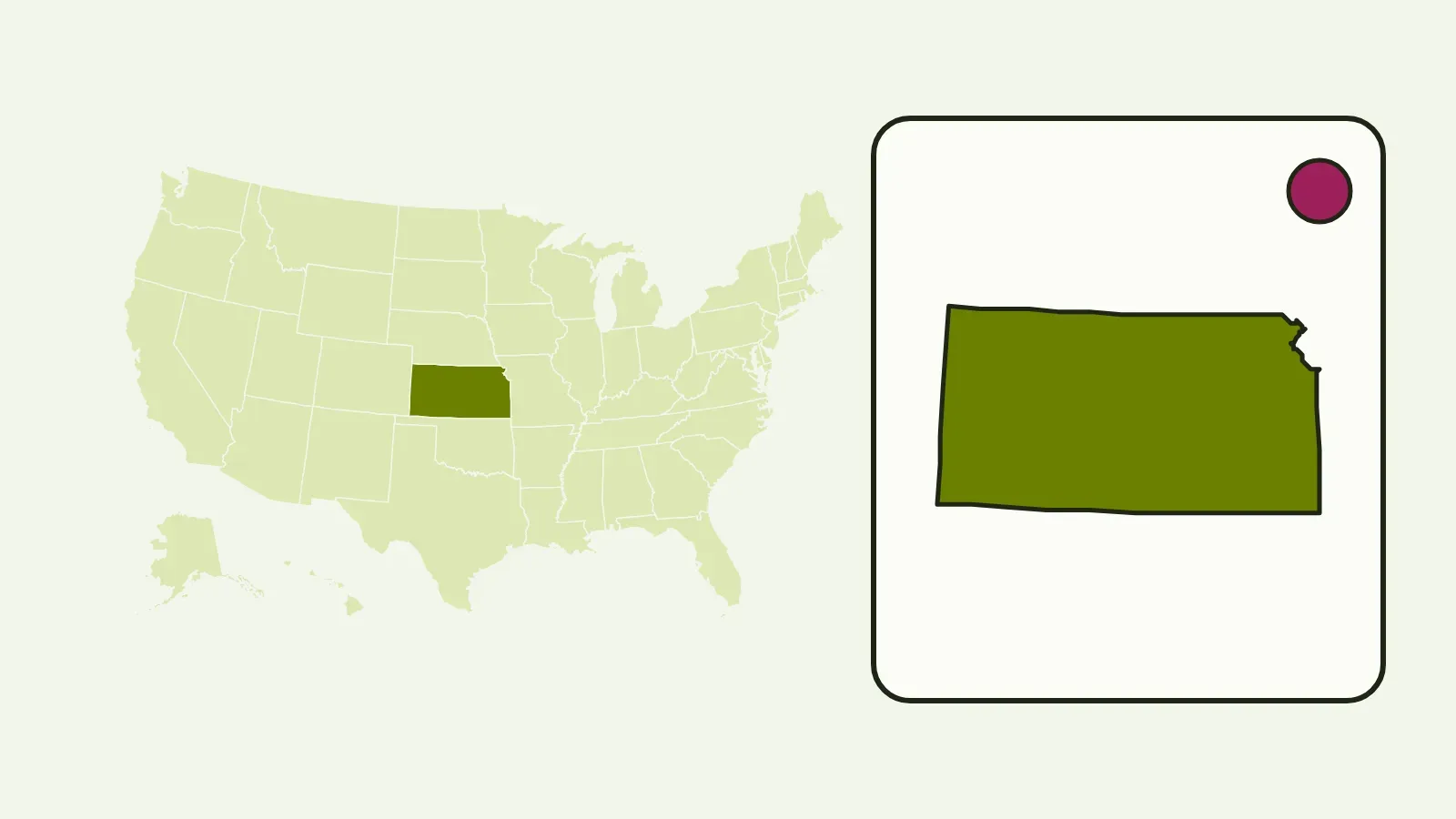
K-State Research and Extension groups Kansas lawn grasses into two kinds. Kentucky bluegrass, tall fescue and perennial ryegrass are cool-season grasses. Bermudagrass, zoysiagrass and buffalograss are warm-season grasses. Both kinds are grown in the state, which is why Kansas sits in the transition belt on the state map.
K-State calls tall fescue a popular choice for Kansas lawns. It greens up early in spring and keeps its color well into fall, and it needs about 1 to 1.5 inches of water a week in summer to stay green. K-State's lawn calendar for cool-season grasses, which names tall fescue and Kentucky bluegrass, runs from March weed control through a September feeding and a November feeding.
The state is large, and K-State's tall fescue publication shows the difference. It times crabgrass preventer to redbud bloom, around April 15, and says that date moves about two weeks earlier in southeast Kansas and about two weeks later in northwest Kansas. The warm-season feeding date moves the same way, as the next section explains.
Mowing and feeding
K-State's mowing guide gives a height range for each grass, and says cool-season grasses are cut at the high end of their range in summer heat. It also gives the one-third rule: never remove more than a third of the grass height in one mowing, so a 3-inch lawn is mowed when it reaches 4.5 inches. See lawn mowing for how the rule sets your schedule.
| Grass | Kind | Mowing height |
|---|---|---|
| Bermudagrass | Warm-season | 1 to 2 inches |
| Zoysiagrass | Warm-season | 1 to 2 inches |
| Buffalograss | Warm-season | 2 to 3 inches |
| Perennial ryegrass | Cool-season | 2 to 3 inches |
| Kentucky bluegrass | Cool-season | 2 to 3.5 inches |
| Tall fescue | Cool-season | 2.5 to 3.5 inches |
The feeding calendar depends on the grass. K-State's fertilizing publication says cool-season lawns are fed mainly in fall and late spring, that September is the most important month, and that a November application helps the turf build food reserves. For warm-season grasses it says to wait until at least May 15 for most of Kansas, or May 30 or later in north-central and northwest Kansas, and to apply no nitrogen after August 15. It advises no more than 1 pound of nitrogen per 1,000 square feet in one application.
That publication is dated 2001 and carries a note to check current K-State guidance, so treat its rates as a starting point and confirm them with your county office. K-State's 2026 calendar for cool-season grasses also puts seeding between late August and mid-October. Turn a label rate into bags with the lawn supplies tool.
Rules for spraying and fertilizer
The Kansas Department of Agriculture says applying any pesticide for compensation, including a lawn fertilizer that contains an herbicide, requires a Kansas pesticide business license. The business must also have at least one employee with a Kansas commercial pesticide applicator certification in the appropriate category. The department's list of employee categories includes 3A (ornamental) and 3B (turf).
For fertilizer, the department says fertilizers and soil amendments must be registered in Kansas before they can be sold. The department pages listed below do not state a statewide limit on how a homeowner or a crew applies lawn fertilizer, so check with your city and your HOA. K-State's fertilizing publication advises sweeping spilled granules off streets and sidewalks so they do not wash into storm drains.
The sources listed below do not describe a separate state license for a mowing or landscaping crew. Mowing and basic yard work are not the same as spraying, so ask any company that offers weed or grub treatments for its license and certification.
- The business's Kansas pesticide business license number
- The category of the certified applicator who will do the work, such as 3A or 3B
- The product name and the rate, in writing
Call 811 and local rules
Kansas 811 takes locate requests around the clock at 811 or 1-800-DIG-SAFE (800-344-7233). Its FAQ refers to the standard minimum notice of two full working days, and it names the Kansas Underground Utility Damage Prevention Act as the governing statute. Call before you dig a post hole, plant a tree or build a deck. The steps are in call 811 before you dig.
Cities, water utilities and homeowners' associations can add rules for grass height, watering and yard work. No particular city's ordinance is covered here, so read yours or ask the city office. The guide to HOA and city yard rules lists what to look for.
Hiring a crew in Kansas
Ask for the pesticide business license number and the certified applicator's category before anyone sprays, and get the product and the rate in writing. The guide to hiring a lawn crew lists what a written quote should say.
Questions people ask
What kind of grass do most Kansas lawns have?
Both kinds are grown. K-State lists Kentucky bluegrass, tall fescue and perennial ryegrass as cool-season grasses, and bermudagrass, zoysiagrass and buffalograss as warm-season grasses, and calls tall fescue a popular choice for Kansas lawns.
When should I fertilize a Kansas lawn?
It depends on the grass. K-State says cool-season lawns are fed mainly in fall, with September the most important month, and warm-season lawns wait until at least May 15 for most of Kansas.
Does a lawn crew need a license to spray in Kansas?
Yes. The Kansas Department of Agriculture says applying any pesticide for compensation requires a pesticide business license, and the business needs an employee certified in the appropriate category.
How much notice does Kansas 811 need?
Kansas 811's FAQ refers to a standard minimum notice of two full working days. Call 811 or 1-800-DIG-SAFE before you dig.
Sources
- Pesticide and Fertilizer Program (Kansas Department of Agriculture)
- Pesticide Business (Kansas Department of Agriculture)
- Mowing Your Lawn, MF1155 (Kansas State University)
- Fertilizing Kansas Lawns, MF2324 (Kansas State University)
- Tall Fescue Lawns, MF736 (Kansas State University)
- Lawn calendar for cool-season grasses (K-State Research and Extension)
- Kansas 811 FAQs
Checked on November 20, 2026. Licensing rules and local ordinances change; confirm with the Kansas Department of Agriculture, your county extension office and your city before you hire or spray.
Next in the yard
-

Yard job
Lawn mowing
How tall to mow, how often, and what a weekly visit includes.
-

Yard job
Lawn fertilizing
When to feed cool- and warm-season lawns, how to size a feeding, and what rules apply.
-

Guide
Call 811 before you dig
How the free 811 locate works, why notice periods differ by state, and who calls when a crew digs.