Warm belt
Mississippi yard facts: grass, season and the rules that apply
Most Mississippi lawns are warm-season grass that grows from spring through fall and goes dormant in winter. Here is how that shapes the jobs, and who regulates the work.
By LawnElm Editorial Team Updated 6 min read
- Grass belt
- Warm-season
- Common grasses
- Bermuda, zoysia, centipede
- Spray for hire
- License required
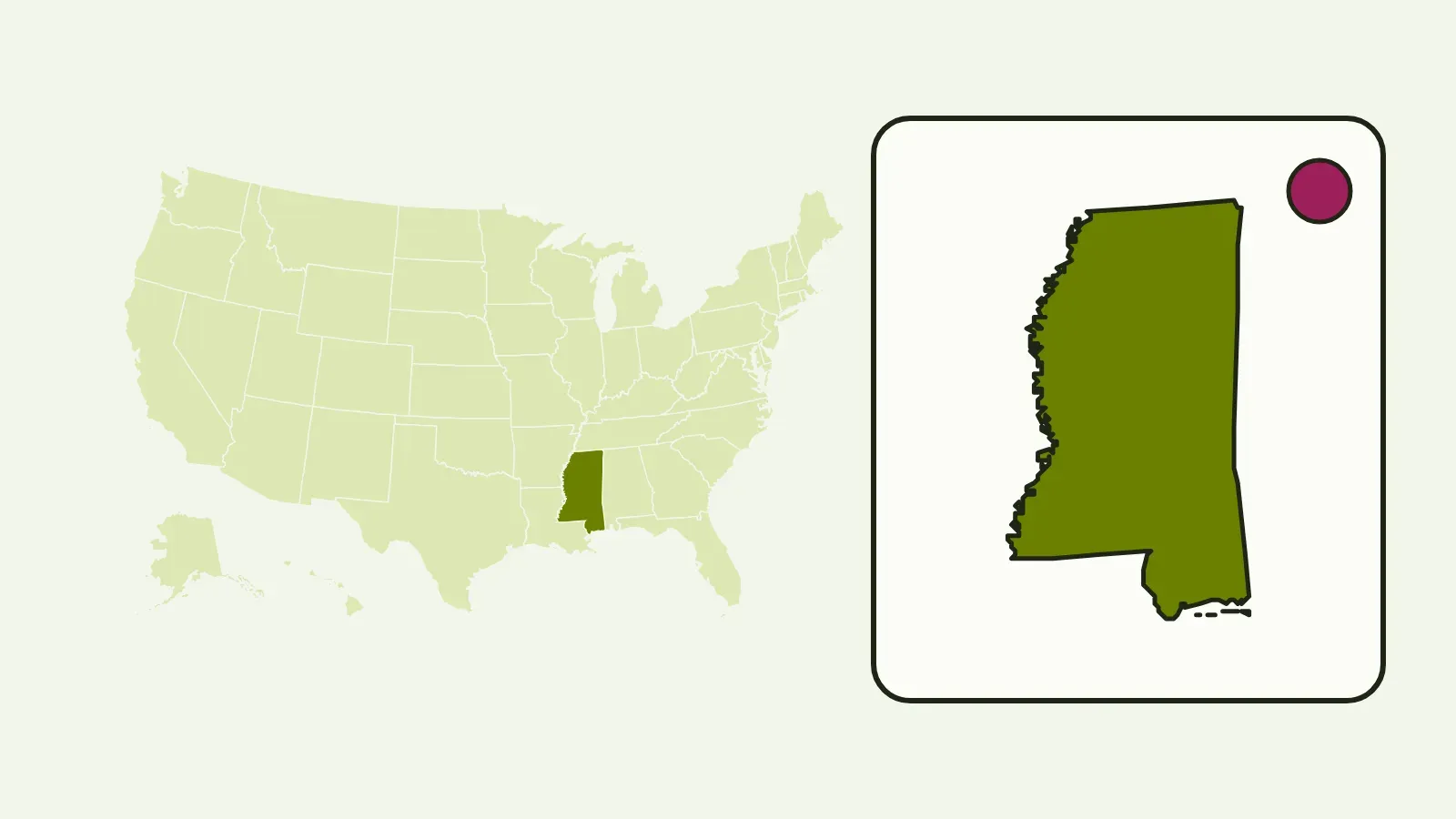
Short version
Most Mississippi lawns are warm-season grasses, which Mississippi State University Extension says grow actively in spring, summer and fall and go dormant in winter. Only the northern counties can grow cool-season grasses as a permanent lawn. A company that sprays lawns for hire needs a company license from the Mississippi Department of Agriculture and Commerce, and its applicators need operator licenses.
Mississippi at a glance
Grass and climate
Mississippi State University Extension's home lawn publication lists the warm-season grasses used in the state: bermudagrass, St. Augustinegrass, centipedegrass, zoysiagrass, carpetgrass, bahiagrass and seashore paspalum. They grow actively in spring, summer and fall and go dormant in winter. The publication defines spring as March 22 through June 21 and says warm-season turf begins its spring transition in March and continues through mid-April.
The state splits by climate zone. The publication says only the northern counties, Zone 7a, can successfully grow cool-season grasses such as tall fescue and Kentucky bluegrass as a permanent lawn. South and central Mississippi (Zones 7b and 8a) and the Gulf Coast (Zone 8b) are the warmer areas where warm-season grasses are mainly grown. It does not recommend St. Augustinegrass or centipedegrass for Zone 7a. If you are in the north and unsure which grass suits your yard, ask your county extension office.
Mowing and feeding
Mississippi State lists a mowing height for each grass, in inches. The one-third rule applies to all of them; lawn mowing explains it.
| Grass | Height (inches) |
|---|---|
| Bermudagrass | 0.5 to 1.5 |
| Zoysiagrass | 1 to 1.5 |
| Centipedegrass | 1.5 to 2 |
| St. Augustinegrass | 2.5 to 3 |
The same publication gives yearly nitrogen rates by zone, in pounds per 1,000 square feet. Hybrid bermudagrass is 3 in Zone 7a, 4 in Zones 7b and 8a, and 6 on the Gulf Coast (8b). St. Augustinegrass is 2 in Zones 7b and 8a and 3 in 8b. Centipedegrass is 1 in Zones 7b and 8a and 2 in 8b. The table also lists the number of applications and the dates. The lawn supplies tool turns a rate like that into bags.
Who regulates what
The Mississippi Department of Agriculture and Commerce runs the pesticide program through its Bureau of Plant Industry. Its professional services page says a business that offers or performs pest control must first get a company license, and the company holder is the primary party responsible for the work. Individual operators and permit holders work under it, and technicians need a registered technician ID to work without direct supervision.
- Lawn pests: horticultural pest control covers insects, diseases and animal pests of ornamental plants and shade trees, and includes lawns in residential, commercial and public areas.
- Lawn weeds: horticultural weed control covers weeds in ornamental plants and turf. Pest and weed work are separate categories, each with its own exam.
- Bonds and insurance: the page lists a $5,000 bond and insurance for pest control, and a $2,500 bond with no insurance for weed control.
The department's commercial applicator certification page is a different track. It covers people who apply restricted-use pesticides when they are not applying for hire. Ask any company that treats your lawn which license it holds, and ask for a copy.
For fertilizer, the Bureau of Plant Industry says it deals with animal feeds, seed, fertilizer, lime and soil and plant amendments. The Mississippi State Chemical Laboratory says its analyses support the Bureau's regulatory work on the quality and labeling of fertilizers sold in the state. The agency pages checked did not show a statewide limit on how a homeowner applies lawn fertilizer, so check your city and homeowners' association before you plan an application.
Calling 811 and local rules
Mississippi's one-call center is MS811. Its excavation guide says that in most situations you should contact MS811 at least 3 and no more than 10 working days before an excavation project. Utilities then have 3 working days to locate their lines on a normal ticket. The guide says anyone engaging in excavation of any kind must notify MS811. Its exemption covers an owner excavating less than 12 inches deep on private property without mechanical equipment. See call 811 before you dig.
Cities, water systems and homeowners' associations can set rules on watering, mowing height and yard appearance. The guide to HOA and city yard rules explains where to look.
Hiring a crew in Mississippi
Mowing does not need a pesticide license, but weed and insect treatments do. Ask for the company license number, the product and the rate in writing. The guide to hiring a lawn crew lists what a written quote should say.
Questions people ask
What kind of grass do most Mississippi lawns have?
Mostly warm-season grasses. Mississippi State University Extension lists bermudagrass, St. Augustinegrass, centipedegrass and zoysiagrass among the common ones. In the northern counties, cool-season grasses can also be grown as a permanent lawn.
Does a lawn spraying company need a license in Mississippi?
Yes. The Department of Agriculture and Commerce says a business offering or performing pest control must first get a company license, and its applicators work under operator licenses. Lawn pests and lawn weeds are separate categories.
Why does my Mississippi lawn turn brown in winter?
Warm-season grasses go dormant in winter, according to Mississippi State University Extension. That is normal for bermudagrass, zoysiagrass, centipedegrass and St. Augustinegrass.
How many days before digging do I call 811 in Mississippi?
MS811 says to contact it at least 3 and no more than 10 working days before an excavation project in most situations. An owner digging by hand less than 12 inches deep on private property is exempt.
Sources
- Establish and Manage Your Home Lawn, P1322 (Mississippi State University Extension)
- Weed and Pest Control License and Permit (Mississippi Department of Agriculture and Commerce)
- Commercial Applicator Certification (Mississippi Department of Agriculture and Commerce)
- Pesticide Program (Mississippi Department of Agriculture and Commerce)
- Bureau of Plant Industry (Mississippi Department of Agriculture and Commerce)
- Mississippi State Chemical Laboratory
- Mississippi Excavation Guide (MS811)
Checked on November 20, 2026. Licensing rules and local ordinances change; confirm with the Mississippi Department of Agriculture and Commerce and your city before you hire or spray.
Next in the yard
-

Yard job
Lawn mowing
How tall to mow, how often, and what a weekly visit includes.
-

Yard job
Lawn fertilizing
When to feed cool- and warm-season lawns, how to size a feeding, and what rules apply.
-

Guide
Call 811 before you dig
How the free 811 locate works, why notice periods differ by state, and who calls when a crew digs.