Cool belt
Nebraska yard facts: grass, season and the rules that apply
Nebraska Extension's lawn calendar is written for cool-season grass, with mowing from April and feeding in spring and fall. Here is how that shapes the jobs, and who regulates the work.
By LawnElm Editorial Team Updated 6 min read
- Grass belt
- Cool-season
- Common grasses
- Bluegrass, tall fescue
- Spray for hire
- License required
Short version
Nebraska Extension's lawn calendar covers Kentucky bluegrass, tall fescue, perennial ryegrass and fine fescues, and has mowing start in April and run until the grass stops growing in fall. The Nebraska Department of Agriculture says anyone who applies lawn care pesticides for hire, even general-use products, must be certified and licensed as a commercial applicator. State law asks an excavator to notify the one-call center at least two full business days before digging.
Nebraska at a glance
Grass and climate
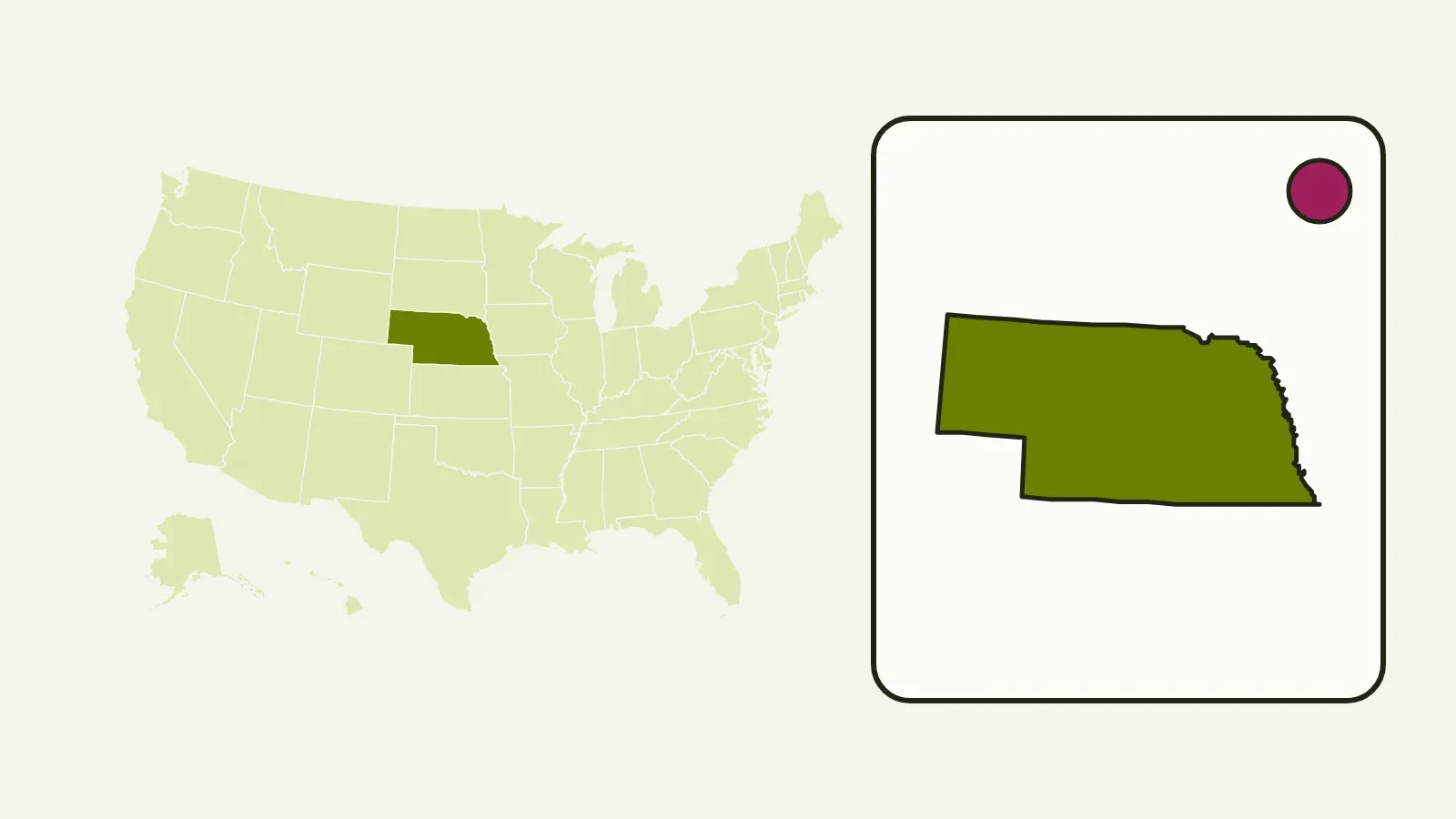
The University of Nebraska Extension's cool-season lawn calendar (G2356, 2023 edition) is written for eastern Nebraska and covers Kentucky bluegrass, tall fescue, perennial ryegrass and fine fescues. That is why Nebraska sits in the cool belt on the state map. The calendar's authors say newer lawns, under about 20 years old, often struggle with low-nutrient soil and high weed pressure, while older lawns need less fertilizer and have lower weed pressure.
The pages read for this article do not cover western Nebraska, where the climate is drier. If you live out there, ask your county Nebraska Extension office which grass and which calendar fit your yard before you reseed. Nebraska Extension's Backyard Farmer mowing page lists warm-season grasses such as bermudagrass, zoysia and buffalograss alongside cool-season ones, but it does not say where in the state each is grown.
- Kentucky bluegrass and tall fescue lead the eastern Nebraska calendar.
- Perennial ryegrass and fine fescues are the other cool-season grasses it covers.
- Overseeding windows on the calendar are April 25 to May 15 and August 15 to September 15.
Mowing and feeding
The calendar says to begin mowing in April as needed, to mow at 3 to 3.5 inches all summer, and never to remove more than one-third of the leaf height at one time. In fall it says to continue mowing until the grass stops growing, in a row dated October 15 to November 1. Nebraska Extension's Backyard Farmer page gives 2.5 to 4 inches as the usual range for bluegrass, fescue and ryegrass, and says mowing might be weekly in the peak growing season of spring and early summer. See lawn mowing for how the one-third rule sets your schedule.
For feeding, the calendar lists 0.75 to 1 pound of nitrogen per 1,000 square feet for a newer lawn from April 25 to May 1, 0.5 pound in the June 1 to 15 window, and 0.5 pound from October 15 to 30. For an older lawn the spring and late-fall feedings are optional, at up to a quarter pound. The calendar also has fall feeding rows in late August to early September and mid-September. Many of its spring feedings come as a combined fertilizer and weed-preventer, so read the product label and check what it contains. The lawn supplies tool turns a rate like that into bags.
On water, the calendar says turf needs 1 inch a week for good growth, counting rain and irrigation together, and that overwatering weakens the turf. It suggests an irrigation audit each summer, which checks how evenly your sprinklers apply water.
Who regulates what
The Nebraska Department of Agriculture (NDA) certifies and licenses pesticide applicators. Its page says that in most cases, using a general-use pesticide needs no license, with two exceptions: structural and lawn care pesticides. People who apply those for hire must be certified and licensed as commercial applicators, whether the product is general-use or restricted-use. To be certified, a person passes a general standards exam and at least one category exam, and the certification is renewed every three years by retesting or by attending University of Nebraska training.
A University of Nebraska Extension article on hiring a professional, dated March 2024, says lawn, tree and landscape professionals are certified in the ornamental and turf category, and that it does not matter whether the product is one a homeowner could buy at a nursery. The same article says landscape professionals do not need a license to apply fertilizer, as long as the product has no pesticide in it, such as a preemergent herbicide. It adds that applicators must carry their license while applying, so ask to see it.
For fertilizer products, NDA's fertilizer program is described as primarily a consumer protection program run under the Nebraska Commercial Fertilizer and Beneficial Substance Act. Firms that manufacture, label or distribute commercial fertilizer must license each facility, and NDA's page says that beginning January 1, 2027, all fertilizer and beneficial substances must be registered for distribution. The page covers the sale of products, not how a homeowner applies fertilizer, so check with your city and your homeowners' association.
Tree work has its own layer. The same UNL article says some Nebraska cities, including Omaha and Lincoln, require professionals providing tree services for hire to hold a city license. See tree trimming.
Call 811 and local rules
Under Section 76-2321 of the Nebraska Revised Statutes, a person must not start an excavation without notice, and notice to the one-call center counts as notice to every operator. The notice must go in at least two full business days, but no more than ten business days, before the dig. Section 76-2323 says each operator must respond with the approximate location of its underground lines no later than two business days after getting the notice, and that marks must last at least five business days on a nonpermanent surface. Since September 1, 2024, it is also a violation to give notice for a dig that cannot reasonably start within 17 calendar days after the start date. The steps are in call 811 before you dig.
Cities, villages, water systems and homeowners' associations can add rules for grass height, watering and yard work. No particular ordinance is covered here, so read yours or ask the local office. The guide to HOA and city yard rules lists what to look for.
Hiring a crew in Nebraska
The pesticide license covers spraying for hire, so ask any company that offers weed, grub or insect treatments for its license number and for the product and rate in writing. For tree crews, ask whether your city requires a license and ask for proof of insurance. The guide to hiring a lawn crew lists what a written quote should say.
Questions people ask
What kind of grass do most Nebraska lawns have?
The University of Nebraska Extension calendar for eastern Nebraska covers Kentucky bluegrass, tall fescue, perennial ryegrass and fine fescues, which are all cool-season grasses. The pages read for this article do not say what share of lawns each grass makes up.
Does a lawn crew need a license to spray in Nebraska?
Yes. The Nebraska Department of Agriculture says people who apply lawn care pesticides for hire must be certified and licensed as commercial applicators, even when the products are general-use.
Does a crew need a license to fertilize my lawn?
A University of Nebraska Extension article says landscape professionals do not need a license to apply fertilizer as long as the product does not include a pesticide, such as a preemergent herbicide.
How many days ahead do I call before digging in Nebraska?
Section 76-2321 says notice must be given at least two full business days, and no more than ten business days, before you start. You may start sooner if every affected operator has said its lines are marked or that it has none there.
Sources
- Cool Season Lawn Calendar, Eastern Nebraska (G2356, University of Nebraska Extension, 2023)
- Mowing (Backyard Farmer, University of Nebraska)
- Hiring a Lawn and Landscape Professional (UNL Water, March 2024)
- Pesticide Applicator Certification and Licensing (Nebraska Department of Agriculture)
- Fertilizer and Ag Lime (Nebraska Department of Agriculture)
- Nebraska Revised Statute 76-2321, excavation notice (Nebraska Legislature)
- Nebraska Revised Statute 76-2323, marking underground facilities (Nebraska Legislature)
Checked on November 20, 2026. Licensing rules and local ordinances change; confirm with the Nebraska Department of Agriculture, your county extension office and your city before you hire or spray.
Next in the yard
-

Yard job
Lawn mowing
How tall to mow, how often, and what a weekly visit includes.
-

Guide
Call 811 before you dig
How the free 811 locate works, why notice periods differ by state, and who calls when a crew digs.
-

Guide
How to hire a lawn crew
Licenses, insurance and written quotes to check before a lawn or landscape crew starts work.