Transition belt
North Carolina yard facts: grass, season and the rules that apply
North Carolina lawns are a mix of cool-season tall fescue and warm-season grasses such as bermuda, centipede and zoysia. Here is how that shapes the jobs, and which paid yard work needs a state license.
By LawnElm Editorial Team Updated 6 min read
- Grass belt
- Transition
- Common grasses
- Tall fescue, bermuda
- Spray for hire
- License required
Short version
North Carolina is a transition-belt state, and NC State Extension calendars cover both tall fescue and warm-season grasses such as bermudagrass, centipedegrass and zoysiagrass. The state Department of Agriculture and Consumer Services requires a pesticide license for commercial applicators who apply any pesticide for pay, and a separate state board licenses landscape contractors. Digging needs notice to the state's 811 center three full working days ahead.
North Carolina at a glance
Grass and climate
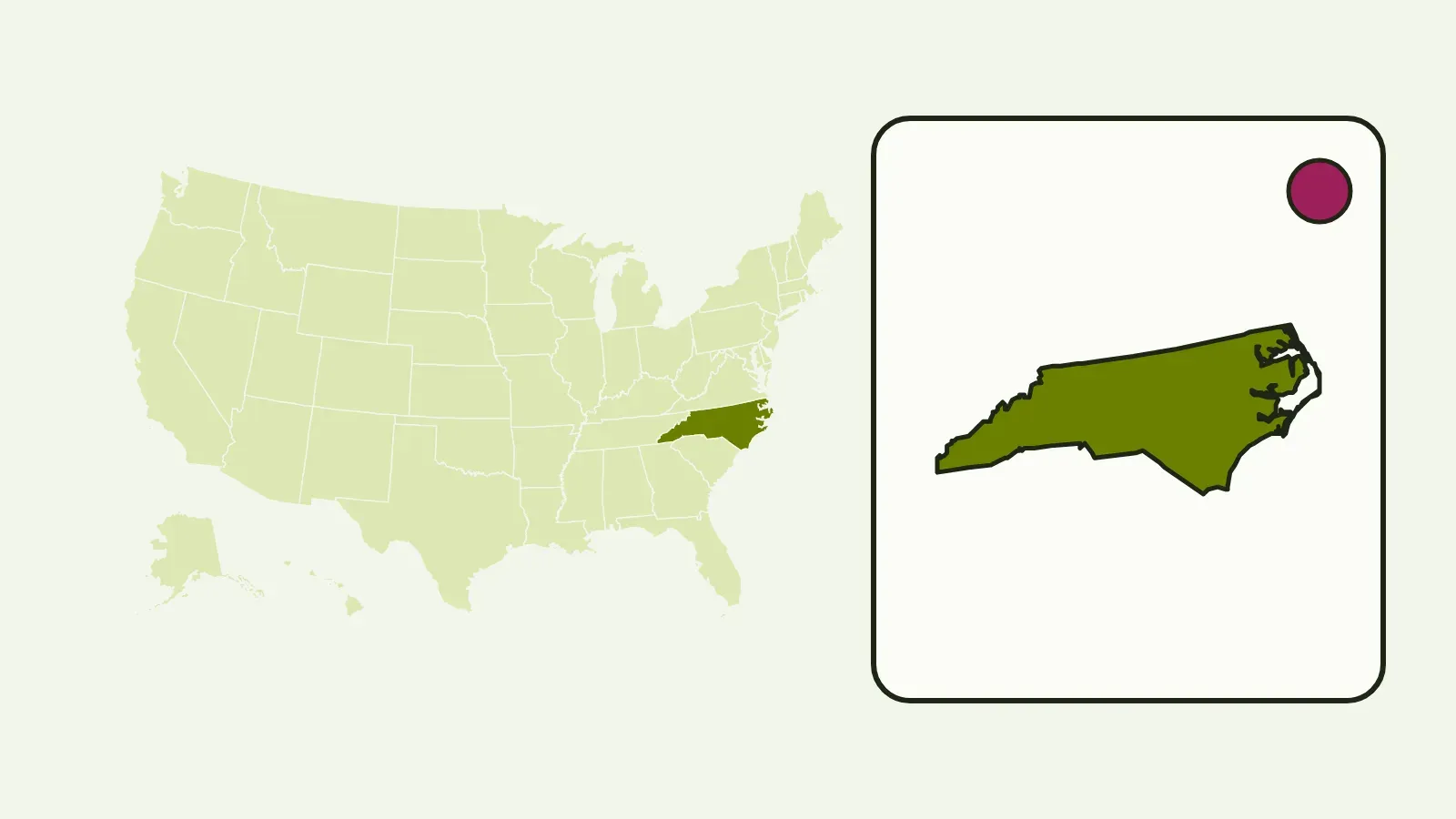
North Carolina sits in the transition belt on the state map, where both cool-season and warm-season grasses grow with effort and neither thrives all year. NC Cooperative Extension's lawn calendar shows it: it lays out a year for tall fescue, a cool-season grass, and a separate set of jobs for warm-season grasses such as bermuda, centipede and zoysia.
For tall fescue, the calendar lists mowing in every part of the year, at 3 to 3½ inches from March to May, 3½ to 4 inches in June to August, 3 to 3½ inches from September to November and 3 inches in winter. It tells readers to overseed from September through October. For warm-season grass it says to plant or reseed in May or June and to overseed with ryegrass in October, when warm-season grass begins to go dormant, if you want a green lawn all winter. The jobs on your yard calendar follow the grass, not the date.
- Bermudagrass is the most drought tolerant of the warm-season choices, according to the Franklin County Extension calendar.
- Centipedegrass does not like shade or tree roots, and takes less nitrogen than the others, the same calendar says.
- Tall fescue does best with about an inch of water a week, and brown patch disease likes high humidity and temperatures above 85 degrees, the calendar adds.
Mowing and feeding
The Nash County Extension guide, written in 2025 by a county agent with an NC State turf specialist, lists mowing heights by grass. It also says to leave the clippings on the lawn, which returns nutrients, and to keep blades sharp. See lawn mowing for how the one-third rule sets your schedule.
| Grass | Mowing height |
|---|---|
| Bermudagrass | 0.75 to 2 inches |
| Centipedegrass | 1 to 2 inches |
| St. Augustinegrass | 2.5 to 4 inches |
| Tall fescue | 2.5 to 3.5 inches |
| Zoysiagrass | 0.75 to 2 inches |
For feeding, the Franklin County calendar gives tall fescue 1 pound of actual nitrogen per 1,000 square feet in mid-September and again in November, and again in February, and says not to fertilize it in June through August. For warm-season grass it says to fertilize in May, June, July and August at ½ to 1 pound of nitrogen per 1,000 square feet, with ½ pound for centipede. The Nash guide says a typical feeding is 1 pound of nitrogen per 1,000 square feet and that many lawns do fine with 1 or 2 pounds a year, and it advises a soil test first. The lawn supplies tool turns a label rate into bags, and the Franklin page works the same arithmetic by hand.
The Nash guide also says not to put fertilizer on frozen ground or dormant turf, to keep it off paved surfaces, and to sweep any spill back onto the lawn. These are extension tips, not state rules.
Who regulates what
The NC Department of Agriculture and Consumer Services (NCDA&CS) says a pesticide license is required for commercial applicators who apply any type of pesticide for compensation. Its license list includes a Commercial Ground Applicator license, and the Ornamental and Turf category is listed as category L. Passing the Core exam is required for all applicator licenses, and licenses must be renewed annually. If a crew sprays your lawn, ask for its license and a copy.
North Carolina also licenses landscape contractors. The Landscape Contractors' Licensing Board administers Chapter 89D of the General Statutes. The Board says the law bars anyone from practicing landscape construction or contracting, or using the title landscape contractor, without a license from the Board. The Board's page does not say which jobs count as landscape construction, so ask the Board or the company about the job you have in mind.
The extension pages read for this guide describe fertilizer timing, rates and runoff, but do not state a statewide limit on how a homeowner applies lawn fertilizer. Ask your city, county or water utility whether it has its own rule.
Call 811 and local rules
North Carolina's Underground Utility Safety and Damage Prevention Act, Article 8A of Chapter 87, says notice to the state notification center must be given no less than three full working days before excavation starts. A working day is every day except Saturday, Sunday and state legal holidays, and the notice expires 28 calendar days after the work start date. The notification center may not charge for a notice.
The Act exempts some digging, including work by the owner of a single-family home on the owner's own land that does not touch a utility right-of-way or easement. Whether a job qualifies depends on those details, so follow the steps in call 811 before you dig and ask the center when in doubt.
Cities, counties, water systems and homeowners' associations can add rules for grass height, watering and yard work. No particular ordinance is covered here, so read yours or ask the local office. The guide to HOA and city yard rules lists what to look for.
Hiring a crew in North Carolina
Mowing does not need a pesticide license, but spraying does. Ask any company that applies weed, grub or disease treatments for its license number, and get the product and rate in writing. Ask a company that plants, builds beds or does other landscape construction whether it holds a landscape contractor license. The guide to hiring a lawn crew lists what a written quote should say.
Questions people ask
What kind of grass do most North Carolina lawns have?
Both kinds. NC Cooperative Extension publishes a lawn calendar for tall fescue and another set of jobs for bermuda, centipede and zoysia, so which one you have depends on your yard and your part of the state.
Does a lawn crew need a license to spray in North Carolina?
Yes. NCDA&CS says a pesticide license is required for commercial applicators applying any type of pesticide for compensation. The Ornamental and Turf category is category L.
Does a landscaper need a license in North Carolina?
The Landscape Contractors' Licensing Board says the law bars practicing landscape construction or contracting, or using the title landscape contractor, without a Board license. Ask the Board which jobs count.
How many days ahead do I call 811 in North Carolina?
The state law says no less than three full working days before excavation starts. It exempts some digging by owners of single-family homes on their own land, so ask the center about your project.
Sources
- Lawn Maintenance / Establishment Calendar (NC Cooperative Extension, Franklin County, 2023)
- Caring for Your Lawns and the Environment (NC Cooperative Extension, Nash County, 2025)
- Pesticide Licenses (NC Department of Agriculture and Consumer Services)
- Landscape Contractors' Licensing Board
- Underground Utility Safety and Damage Prevention Act, Article 8A (NC General Assembly)
Checked on November 20, 2026. Licensing rules and local ordinances change; confirm with the NC Department of Agriculture and Consumer Services, the Landscape Contractors' Licensing Board and your city before you hire or spray.
Next in the yard
-

Yard job
Lawn mowing
How tall to mow, how often, and what a weekly visit includes.
-

Yard job
Lawn fertilizing
When to feed cool- and warm-season lawns, how to size a feeding, and what rules apply.
-

Guide
How to hire a lawn crew
Licenses, insurance and written quotes to check before a lawn or landscape crew starts work.