Cool belt
Washington yard facts: grass, fertilizer law and the rules that apply
Washington lawns are cool-season grass, and the state limits phosphorus in turf fertilizer. Here is how that shapes the jobs, and who regulates the work.
By LawnElm Editorial Team Updated 5 min read
- Grass belt
- Cool-season
- Common grasses
- Ryegrass, fescue
- Fertilizer law
- Phosphorus limits
Short version
Washington State University Extension recommends cool-season grasses for Washington lawns: turf-type perennial ryegrass, fine fescue and bentgrass west of the Cascades, and Kentucky bluegrass, fine fescue and turf-type tall fescue east of them. A 2011 state law bars most phosphorus fertilizer on turf, and the Washington State Department of Agriculture licenses businesses that apply pesticides to other people's property. The state's dig law asks for two to ten full business days of notice before you dig.
Washington at a glance
Grass and climate
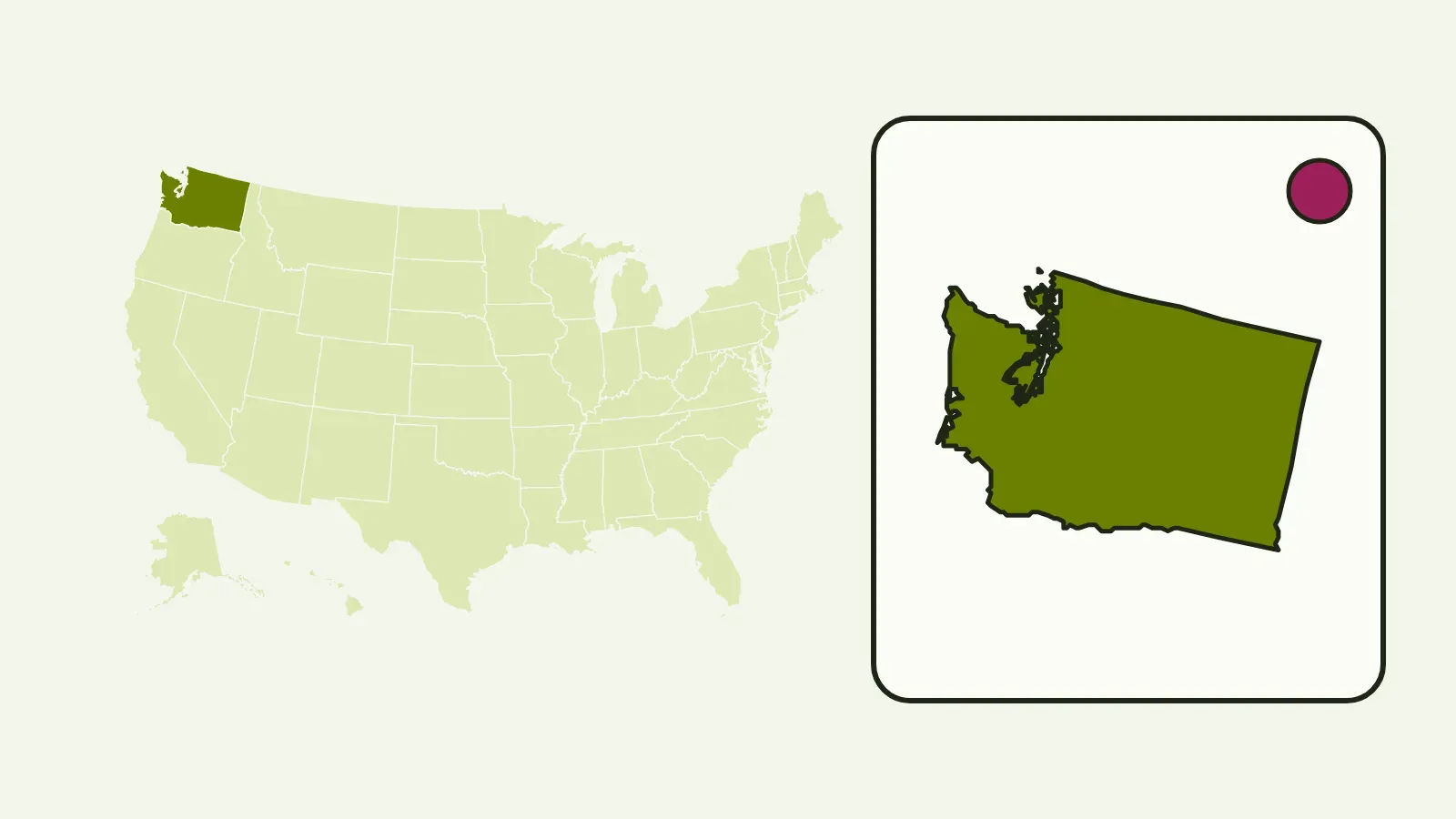
Washington State University Extension splits the state at the Cascades. Its Pacific Northwest Gardener's Handbook says Kentucky bluegrass, fine fescues and turf-type tall fescues are best for areas east of the Cascades, while turf-type perennial ryegrasses, fine fescues and bentgrasses are well adapted west of them. Both sides grow cool-season grasses, which is why Washington sits in the cool belt on the state map.
- Perennial ryegrass is extremely wear-tolerant and blends well with other grasses west of the Cascades, according to WSU. It needs moderate to high nitrogen.
- Fine fescues need little fertilizer compared with other types and are shade-tolerant on both sides of the Cascades, WSU says.
- Kentucky bluegrass is well adapted east of the Cascades but not to western Washington, where WSU says to use only the best recommended cultivars.
- Tall fescue does well in eastern Washington. In the west, WSU says its slow winter growth lets other grasses invade.
Mowing and feeding
WSU's handbook does not give a start and end date for the mowing season, so this page does not either. It does give heights. It says to lower the cutting height no more than half an inch per mowing and to remove no more than 30 percent of the leaf blade in one cut. See lawn mowing for how that sets your schedule.
| Grass | West of the Cascades | East of the Cascades |
|---|---|---|
| Kentucky bluegrass | 1 to 2.5 | 1.5 to 3 |
| Fine fescue | 1 to 2.5 | 1.5 to 3 |
| Perennial ryegrass | 1 to 2.5 | 1.5 to 3 |
| Tall fescue | 2 to 3 | 2 to 3 |
WSU notes that the 1.5-inch figure for Kentucky bluegrass is for athletic fields and that home lawns are cut higher. For a moderately maintained established lawn it suggests 4 pounds of nitrogen per 1,000 square feet a year in four applications of 1 pound each: about May 1, June 15 to 30, September 15 and November. November is early east of the mountains and late west of them. It says not to fertilize in hot weather and to start with a soil test. The lawn supplies tool turns a rate like that into bags.
Rules for fertilizer and spraying
The Washington State Department of Agriculture says the 2011 law "Clean Fertilizers, Healthier Lakes and Rivers" (ESHB 1489) prohibits retail sales, displays and use of fertilizers containing phosphorus on turf. Turf means residential, commercial and publicly owned land, including home lawns, parks, golf courses and schools. The law does not apply to pasture, sod farms or residential vegetable and flower gardens.
Phosphorus fertilizer is allowed to establish new seeding or sod, to repair damaged grass during the growing season in which it was established, and when a soil test within the last 36 months shows the soil is deficient in phosphorus. WSU cites RCW 15.54.500 for the same law and says maintenance fertilizer on an established lawn should have a 3-0-2 or 6-0-4 formulation.
WSDA defines a commercial applicator as a person in the business of applying pesticides to the land or property of another. Its license category list, effective January 1, 2026, says every license except a few (such as private applicator) needs the Washington Laws and Safety exam plus a category exam. The Weed Control category covers weeds in turf and ornamental settings. The Insect and Disease Control category covers turf and yards. A separate limited-specialty category covers moss on structures and turf.
- The business's WSDA commercial applicator license number
- The category the applicator holds, such as Weed Control or Insect and Disease Control
- The product name and the rate, in writing
The WSDA pages listed below do not describe a state license for mowing or landscaping work in general, so ask any crew that offers weed, moss or insect treatments for its pesticide license.
Call 811 and local rules
The Washington Utilities and Transportation Commission says changes to the state's dig law (RCW 19.122) took effect July 27, 2025 and apply to anyone excavating, including homeowners. Mark the dig area with white lines, then call 811 or visit callbeforeyoudig.org no less than two full business days and no more than 10 full business days before the work starts. Locate marks last up to 45 days. Since January 1, 2026, you may not start digging until every operator with underground facilities in the notice area has responded. The call and the locates are free. The steps are in call 811 before you dig.
Cities, water utilities and homeowners' associations can add rules for watering, grass height and yard work. No particular Washington city's ordinance is covered here, so read yours or ask the city office. The guide to HOA and city yard rules lists what to look for.
Hiring a crew in Washington
Ask for the pesticide license number and category before anyone sprays, and get the product and the rate in writing. The guide to hiring a lawn crew lists what a written quote should say.
Questions people ask
What kind of grass do most Washington lawns have?
Cool-season grasses. WSU Extension recommends turf-type perennial ryegrass, fine fescues and colonial bentgrass west of the Cascades, and Kentucky bluegrass, fine fescues and turf-type tall fescue east of them.
Can I use fertilizer with phosphorus on my Washington lawn?
Only in limited cases. The Washington State Department of Agriculture says phosphorus fertilizer is allowed to establish new grass, to repair damaged grass in the season it was established, and when a soil test taken within 36 months shows a deficiency.
Does a lawn crew need a license to spray in Washington?
WSDA licenses commercial applicators, meaning people in the business of applying pesticides to another person's land or property. Ask the crew for its license number and category.
How much notice does Washington's 811 need?
The Utilities and Transportation Commission says to call 811 no less than two full business days and no more than 10 full business days before you dig, after marking the area with white lines.
Sources
- Restrictions on Turf Fertilizers Containing Phosphorus (Washington State Department of Agriculture)
- Pesticide License Categories (Washington State Department of Agriculture)
- Commercial Applicators and Structural Pest Inspectors (Washington State Department of Agriculture)
- Chapter 10, Lawns (Pacific Northwest Gardener's Handbook, WSU Extension)
- Changes to Washington dig law take effect July 27 (Washington Utilities and Transportation Commission)
Checked on November 20, 2026. Licensing rules and local ordinances change; confirm with the Washington State Department of Agriculture, your county extension office and your city before you hire or spray.
Next in the yard
-

Yard job
Lawn mowing
How tall to mow, how often, and what a weekly visit includes.
-

Yard job
Lawn fertilizing
When to feed cool- and warm-season lawns, how to size a feeding, and what rules apply.
-

Guide
Call 811 before you dig
How the free 811 locate works, why notice periods differ by state, and who calls when a crew digs.